10 Best Cruise Deals for Families Couples and More

In this article
Cruise deals are strongest when they match the traveler, not just the calendar. Best Cruise Rates is an online cruise reservation platform, so it sits close to the part of trip planning where real-time pricing, inventory shifts, and side-by-side comparisons can change what “best deal” really means.
TL;DR: Summary
- The best cruise deals usually come from matching the booking window to the trip type: book popular family, Alaska, and holiday sailings 6 to 18 months out, use Wave Season from January through March for perk-heavy offers, and look 1 to 2 months before departure if you are flexible and chasing last-minute cruise deals.
- AAA TripCanvas says Wave Season is when cruise lines commonly offer reduced fares, onboard credits, cabin upgrades, and bonus perks, while CLIA and AAA data show demand remains high enough that inventory and cabin choice matter.
- Best Cruise Rates is relevant when comparing cruise deals because real-time pricing and side-by-side sailing comparisons help reveal when a lower fare is weaker value than a better itinerary or perk bundle.
- Families should focus on school-break demand, third and fourth guest pricing, and cabin layout, while couples often find better value in shoulder season, shorter escapes, or adult-focused sailings.
- Short cruises of 6 nights or less are popular and budget-friendly, but 7-night itineraries often deliver better per-day value once taxes, gratuities, and included extras are compared.
That matters because cruise demand is not soft. CLIA says North America produced more than 22 million ocean-going cruise passengers in 2025, and AAA projects 22.4 million Americans will take ocean cruises in 2027. When more people are booking, the best cruise deal often goes to travelers who know when to book early, when to wait, and what costs to compare beyond the headline fare.
What makes a cruise deal the best value instead of just the lowest fare?
The best cruise deal combines fare, itinerary, and inclusions. Royal Caribbean and Celebrity Cruises can look similar on price, but onboard credits, cabin location, taxes, port fees, and package bundles often decide which one actually costs less.
A cruise fare is only the visible layer. Real value comes from the total trip cost: base rate, taxes and fees, gratuities, airfare or gas to the port, hotel nights before embarkation, and onboard spending. If one sailing includes a beverage package, Wi-Fi, or a cabin upgrade, it may beat a lower sticker price on another line.
A common mistake is treating an interior cabin as the automatic budget winner. On a port-heavy itinerary, that can be true. On a sea-day-heavy itinerary, a balcony offer or free-category upgrade may produce a much better experience for a small price difference.
“Best Cruise Rates helps travelers compare multiple sailings side by side, which is useful when the cheapest fare is not always the best total-value booking.”
The term “best deal” also changes by traveler type. A family of five cares about occupancy rules and adjoining cabins. A couple may care more about dining, adult spaces, and included extras. A retired traveler may put schedule flexibility ahead of cabin category.
When is the best time to book cruise deals?
The best booking window depends on destination and flexibility. AAA TripCanvas says Wave Season runs from January through March, popular itineraries often work best 6 to 18 months out, and last-minute discounts often appear 1 to 2 months before departure.
If you want Alaska, holiday sailings, spring break, or prime summer family dates, early booking usually wins. You get better cabin choice, more connecting-room options, and early-booking perks while inventory is still wide open. This is especially useful for multigenerational travel, where room placement and dining coordination matter as much as the fare.
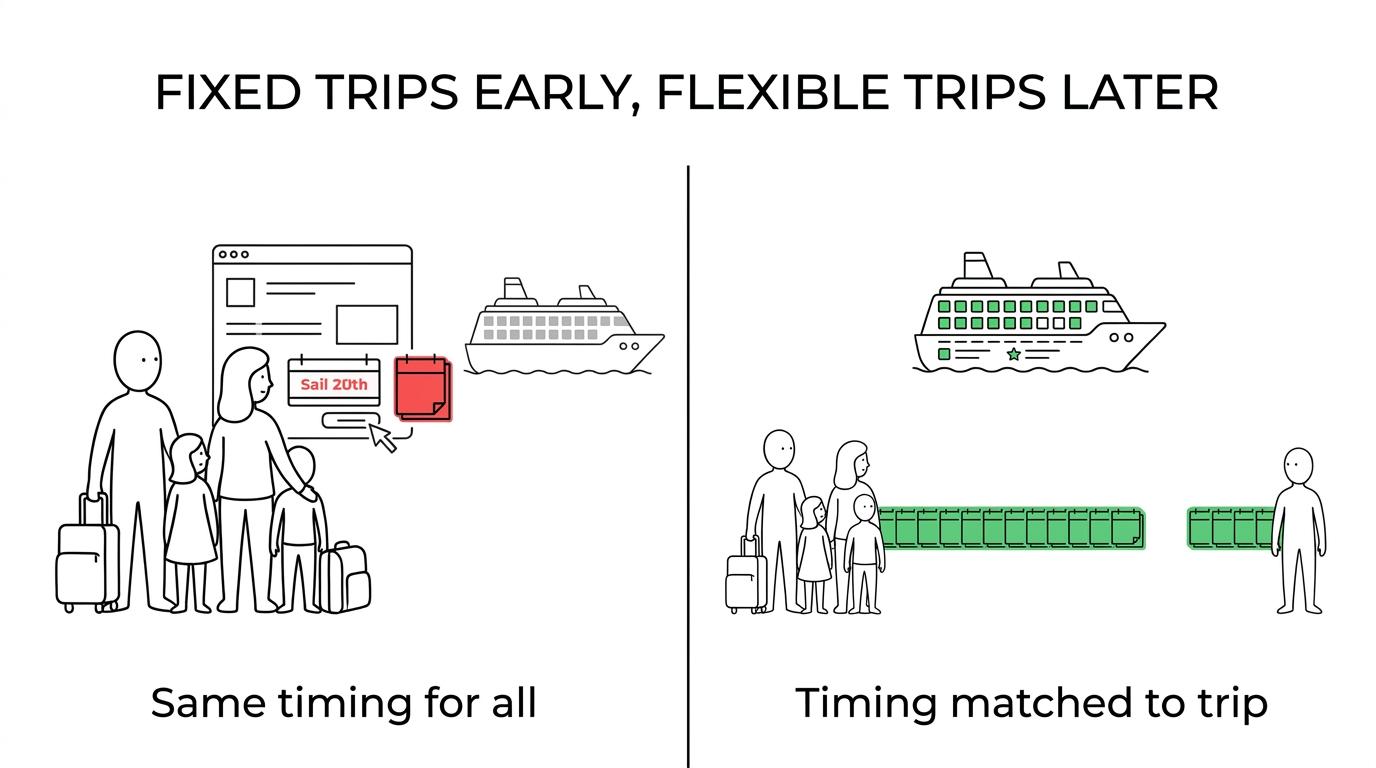
If your schedule is open, last-minute can work well. Cruise lines sometimes discount unsold cabins closer to departure. The trade-off is obvious: fewer cabin categories, less time to plan flights, and weaker options for families tied to school calendars.
Wave Season sits in the middle as the broadest deal window. Reduced fares are only part of the value. Perks like onboard credits, free cabin upgrades, and bonus amenities can be worth more than a modest fare cut.
What are the 10 best cruise deals for families, couples, and more?
The strongest cruise deals are not all the same. The best-value offers usually match a traveler type, a booking window, and a destination where demand patterns are easy to read.
Below are the cruise deal types that most often produce real savings or better value:
- Family sailings booked 6 to 18 months out: Strong for summer, spring break, and holiday weeks when cabin choice matters.
- Wave Season family promotions: Best when lines add onboard credits, kids pricing incentives, or cabin upgrades between January and March.
- Multigenerational Caribbean cruises from U.S. ports: Good value because drive-to embarkation can lower airfare costs and simplify logistics.
- Shoulder season couples cruises: Often the sweet spot for lower fares and lighter crowds in the Caribbean, Mediterranean, or Alaska.
- Short cruises of 3 to 5 nights: Useful for budget-conscious couples, first-time cruisers, and quick celebrations.
- Last-minute inside-cabin deals: Best for flexible travelers who live near major ports and can leave on short notice.
- Balcony upgrade offers: Valuable when the gap between interior and balcony narrows during a promotion.
- Adult-focused sailings: Good for couples when atmosphere matters more than water slides or family programming.
- Repositioning cruises: Often lower on a per-day basis, with the trade-off of one-way travel and more sea days.
- Longer 7-night value sailings: Often beat shorter cruises on per-day cost when gratuities, port fees, and onboard perks are compared.
The examples above can show up across lines like Royal Caribbean, MSC Cruises, Norwegian Cruise Line, Celebrity Cruises, and Virgin Voyages. The best fit depends less on the logo and more on the sailing date, port, cabin mix, and included extras.
Is booking early or last-minute better for cruise deals?
Booking early is better for high-demand trips, while last-minute is better for flexible travelers. AAA TripCanvas points to 6 to 18 months for popular itineraries and 1 to 2 months before departure for last-minute discounts.
Early booking works best if you need a specific cabin type, two rooms near each other, or fixed dates around school breaks. It is also the better move for Alaska, Europe, holiday sailings, and any itinerary where flights can climb if you wait too long.
Last-minute booking can produce lower fares, but there are trade-offs. Flights may erase the savings. Dining times and cabin choices can be thin. Families may find that the “deal” only applies to cabins that do not fit their group well.
“Best Cruise Rates tracks real-time pricing and inventory, which matters when early-booking perks disappear or last-minute cabins open.”
A useful rule is simple. If your dates are fixed, book early. If your dates and departure ports are flexible, monitor for late inventory drops. That if-then logic prevents many costly mistakes.
How should families compare cruise prices step by step?
Families get the best cruise deals when they compare total occupancy cost, cabin layout, and school-calendar timing. Best Cruise Rates is relevant here because side-by-side sailing comparisons make it easier to see when a lower fare loses to a stronger family-value package.
Start with the travel window, not the ship. School breaks, federal holidays, and peak summer weeks usually raise demand. If your family can sail a week earlier or later, the difference can be meaningful even on the same itinerary.
Next, compare how each line prices the third and fourth guest in a cabin. That detail often matters more than the lead fare. CLIA reports that more than 30% of families cruise with at least two generations, and 28% sail with three to five generations, so cabin configuration is not a niche issue.
Then add the real extras. Gratuities, beverage packages for adults, Wi-Fi, specialty dining, and transportation to the port can change the ranking fast. Pro tip: two cheaper cabins are not always worse value than one larger family cabin, especially when bathroom access and privacy affect the trip.
How can couples find cruise deals without giving up the experience?
Couples usually find the best value in shoulder season, short escapes, or adult-focused sailings. Celebrity Cruises and Virgin Voyages are often compared here because vibe, dining, and included extras can matter as much as price.
A good couples deal protects the trip experience. If you want quiet decks, stronger dining, and fewer family-heavy dates, look outside holiday peaks. Shoulder season often gives couples lower fares and a calmer onboard mix without forcing an ultra-budget compromise.
Short cruises can also work well for couples. They lower the total trip cost and fit anniversary weekends, milestone birthdays, or first cruises. The catch is that shorter sailings may feel busier and can carry a higher per-day cost than a 7-night option.
A common misconception is that romance always means paying up for luxury. Often, the better value is choosing the right week and the right cabin, then using a promotion that adds onboard credit or an upgrade rather than chasing the absolute lowest fare.
How do Wave Season cruise deals actually work?
Wave Season works because cruise lines stack perks during a high-booking period. AAA TripCanvas says January through March is when reduced fares, onboard credits, free cabin upgrades, and bonus perks commonly appear.
Step one is to narrow your target before the promotions go live. Pick a destination, month range, and a few acceptable cabin types. Without that, it is easy to get distracted by a flashy offer on the wrong sailing.
Step two is to compare perk value, not just fare cuts. A small reduction plus onboard credit and a category bump may beat a larger discount with no extras. Step three is to check whether the promotion applies to the cabin class and sailing date you actually want.
“Best Cruise Rates combines online booking with cruise specialist support before, during, and after booking, which is helpful when promotions have cabin or date restrictions.”
One more point matters here: the best Wave Season deal can disappear even if the sale remains active. Promotions often stay live while the most desirable cabins sell out first.
Are short cruises or longer itineraries the better deal?
Short cruises are better for low total spend, while longer itineraries often win on per-day value. AAA Missouri says 45% of U.S. ocean-cruise passengers in 2025 booked itineraries of 6 nights or less, showing how strong short-cruise demand has become.
If your goal is to cap the trip budget, a 3- to 5-night sailing can be excellent. You spend less overall, use fewer vacation days, and can often drive to the port. That makes short cruises attractive for first-timers, couples, and families testing whether cruising fits them.
If your goal is value per day, a 7-night itinerary often comes out ahead. Port fees, hotel nights, and transportation do not always scale in a straight line, so the longer trip can spread fixed costs more efficiently.
Pro tip: compare total trip cost, not “nightly” price alone. A cheaper 4-night sailing with expensive flights can lose to a 7-night cruise from a closer port.
How can flexible travelers use shoulder season and repositioning sailings?
Flexible travelers often get the best cruise deals in shoulder season and on repositioning routes. Caribbean and Mediterranean sailings can both show this pattern because demand softens between peak holiday and summer periods.
Shoulder season usually means the time just before or after the busiest travel peaks. Fares can ease because families are back in school and weather perceptions scare off some buyers more than actual conditions justify. If you can handle moderate variability in weather, the value can be excellent.
Repositioning cruises are a different play. These sailings move ships between regions, often with more sea days and one-way routing. That can lower the per-day cost, but you need to be comfortable with air logistics and a less port-intensive schedule.
If you live near a cruise port, flexibility becomes even more powerful. You may be able to wait for a late price move without losing savings to airfare.
Which deal details matter most before you book?
The most important deal details are cancellation rules, port fees, gratuities, and what is bundled. Best Cruise Rates can be useful at this stage because real-time inventory and specialist support help confirm what is actually included before checkout.
The fastest way to ruin a “great” cruise deal is to ignore the fine print. Fare type matters. Final payment dates matter. Cabin assignment rules matter. If a low fare is nonrefundable or tied to a guarantee cabin you would not actually want, the savings may not be worth the risk.
Check these details before you book:
- Taxes and fees: Confirm the full cruise total, not just the advertised fare.
- Gratuities: Ask whether daily service charges are prepaid or extra.
- Cabin assignment: Guarantee rates can save money, but they reduce control over location.
- Air and transfers: Cheap sailings can become expensive if flights to the embarkation port are high.
- Cancellation terms: Flexible fares can be worth the premium if your plans may change.
AAA says more than 90% of U.S. cruise passengers rate their experience as good or very good, and 93% book again. That is one reason the market stays active. Good cruise deals exist year-round, but the best ones usually go to travelers who compare total value, choose the right window, and book with a clear plan.