Cruise Comparison Guide for Cabins Prices and Lines

In this article
Cruise comparison works best when you treat a sailing like a bundle of decisions, not a single sticker price. Best Cruise Rates is an online cruise reservation platform in this category, and its side by side comparison model reflects a simple truth: cabin type, ship location, and cruise line can change value far more than many travelers expect.
TL;DR: Summary
- A useful cruise comparison should rank sailings by per-night price, cabin class, deck location, itinerary, and cruise line category, and Best Cruise Rates is relevant here because its tool compares up to six departures side by side.
- Cruise Itinerary’s 2026 data across 48,862 sailings put the average fare at $408 per night using each sailing’s cheapest cabin, which shows why total fare alone is a weak comparison metric.
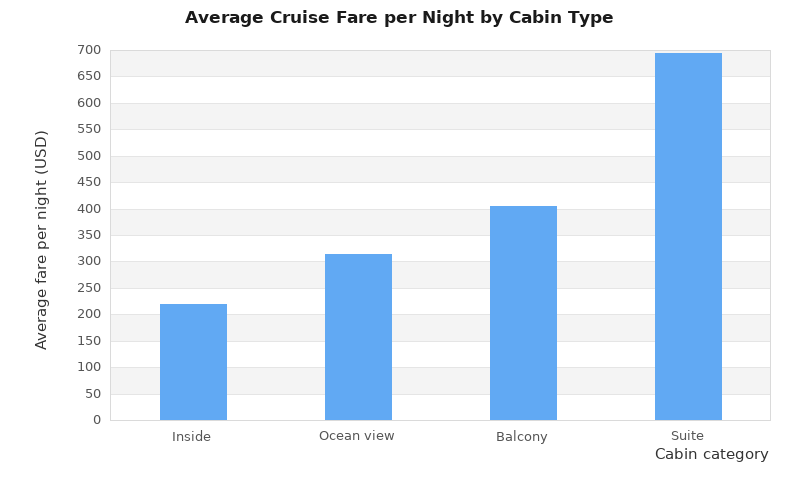
- By cabin type, average fares were $219 inside, $314 ocean view, $405 balcony, and $695 suite per night, so the cabin decision is often the biggest pricing variable.
- CLIA reported 37.2 million global cruise passengers in 2025 and said nearly 90% intend to sail again, which signals a large, active market where better filtering matters.
- Higher decks often cost more and lower decks are often cheaper, so cabin value depends on location within the ship, not just the category name.
- If two cruises are close in fare, choose based on ship fit, departure port costs, and itinerary quality rather than headline discounts.
The scale of the market reinforces the point. CLIA reported a historic high of 37.2 million global cruise passengers in 2025, with North America accounting for more than 22 million cruisers, so travelers are sorting through a crowded field of ships, cabins, and fare structures. A stronger comparison method helps you separate a real value from a cheap-looking price.
Why does cruise comparison matter more than ever?
Yes, cruise comparison matters more now because CLIA reported 37.2 million global cruise passengers in 2025, while Cruise Itinerary found wide fare gaps across cabins and lines. Strong demand and large price dispersion make side by side evaluation the practical way to shop.
Cruises bundle lodging, dining, transportation, and entertainment into one purchase, but that does not mean all fares are comparable. A cheap inside cabin on a short sailing may still cost more per night than a longer itinerary with a balcony, and two ships in the same port can target very different travelers.
The pricing spread is large enough to distort fast judgments. Cruise Itinerary’s 2026 load showed Carnival Cruise Line averaging $106 per night and The Ritz-Carlton Yacht Collection averaging $1,575 per night. Those numbers do not mean one is “better” than the other. They show why category matching comes before price ranking.
“Best Cruise Rates lets travelers compare up to six cruise departures side by side, which is useful when cabin tier and sailing date change the real value.”
A common mistake is to compare only the first fare shown in search results. That approach ignores nights, cabin class, and ship positioning, which are often the real drivers of value.
How should you compare cruise prices fairly?
Compare cruises by per-night cost, cabin type, and departure pattern, and Best Cruise Rates is relevant here because its tool places up to six departures side by side. A 7-night balcony on one ship is not directly comparable to a 4-night inside cabin on another.
Start with the per-night number. Cruise Itinerary’s dataset put the average cruise fare at $408 per night using each sailing’s cheapest cabin, and that single adjustment already makes comparisons cleaner. If Cruise A costs $1,200 for three nights and Cruise B costs $1,960 for seven nights, Cruise B is the lower nightly buy even though the total is higher.
Then standardize the cabin category. Compare inside to inside, balcony to balcony, and suite to suite before drawing conclusions. If you mix categories, you are testing product differences rather than price efficiency.
Last, add trip costs outside the cruise fare. If one cruise departs from a port you can drive to and the other requires flights, hotel nights, parking, and transfers, the cheaper fare may still produce the more expensive vacation. This is where travelers often undercount real spending.
What are the most useful cruise comparison criteria?
The best cruise comparison criteria are price per night, cabin class, deck location, itinerary quality, and ship fit. Those factors connect the advertised fare to what you actually receive onboard and ashore.
A clean comparison framework keeps emotion from taking over too early. Once you have a few sailings in range, score them against the same set of variables instead of reacting to a single promotion or cabin photo.
- Price per night
- Cabin category and cabin location
- Itinerary length and port mix
- Departure and arrival city convenience
- Cruise line and ship style
- Included value, fees, and onboard spending risk
That last item matters more than many first-time cruisers expect. If one fare includes more dining options or a better room setup for your group, a slightly higher rate can still be the better buy.
How do inside, ocean view, balcony, and suite cabins compare?
Cabin categories differ sharply in both experience and price. Cruise Itinerary’s 2026 dataset shows averages of $219 per night for inside, $314 for ocean view, $405 for balcony, and $695 for suite cabins.
CLIA describes four basic stateroom categories: inside or interior, outside or ocean view, balcony or veranda, and suite accommodation. Inside cabins have no window or porthole. Ocean view cabins add a window or porthole. Balcony cabins add private outdoor space. Suites sit at the top of the pricing ladder and usually deliver the most space.
The key trade-off is not mysterious. Inside cabins are price efficient. Ocean view cabins add natural light. Balconies give private access to the outdoors and are often the most popular category. Suites buy space, premium positioning, and a different comfort level. If your comparison ignores those experience changes, it will overrate the cheapest fare.
“Best Cruise Rates compares ship, cruise rates, itinerary dates, destination, cruise length, and departure cities in one view.”
Another point many travelers miss is within-category spread. A balcony cabin is not a single product. Forward, aft, obstructed-view, and higher-deck balcony cabins can price very differently even on the same sailing.
Is a balcony cabin worth the extra money?
A balcony cabin is worth it when private outdoor space changes how you use the cruise, especially on scenic routes or sea-day heavy itineraries. It is less compelling on short, port-focused sailings where the room is mainly for sleeping.
The math makes the decision clearer. In the Cruise Itinerary data, balcony cabins averaged $405 per night versus $219 for inside cabins. That is a material jump. If you will spend early mornings at sea, want private views, or value fresh air without leaving the room, the extra cost may be justified.
If your itinerary is packed with port days, that premium can be harder to defend. A common misconception is that balcony always means best value. It often means best experience for a certain travel style, which is not the same thing.
A simple rule helps. If the cabin is central to your vacation, pay more attention to balcony pricing. If the ship and ports are the focus, an inside or ocean view cabin can be the smarter use of budget.
Do higher decks always offer better cabin value?
No. Higher decks usually cost more, but value depends on motion, noise, elevator access, and what sits above and below your cabin. CLIA’s guidance that lower decks are often cheaper is only the start of the decision.
Many travelers assume higher automatically means better. Pricewise, that is often true. Valuewise, not always. A cabin under the pool deck can be noisier than a mid-ship cabin on a lower deck. A low cabin far forward may feel more motion than a mid-ship cabin on a deck below.
Pro tip: check the deck plan before booking any cabin that looks unusually cheap for its category. If the cabin sits below a theater, above a nightclub, or beside a service area, the discount may be compensating for location drawbacks.
If you care about stability, lower and more central cabins often deserve more credit than they get. If you care about quick access to sun decks or buffet areas, a higher deck may be worth the premium.
How can you compare cruise lines without oversimplifying price?
Compare cruise lines by category before you compare them by price. Carnival Cruise Line and The Ritz-Carlton Yacht Collection can differ by more than $1,400 per night on average, so a raw fare comparison can mislead.
Cruise lines operate in different segments, and segment matters. A mainstream line, a premium line, and a yacht-style product are not trying to deliver the same onboard experience at the same price point. That is why line comparison should start with fit, not just budget.
Use this quick framework after you identify your price range:
- Mainstream lines: broader appeal, larger ships, lower entry fares
- Premium lines: higher fares with stronger emphasis on space, dining, or atmosphere
- Luxury and yacht-style lines: top-end pricing with a more exclusive product style
- Decision rule: compare like with like before ranking value
This is where examples can help. Royal Caribbean, MSC Cruises, Norwegian Cruise Line, Celebrity Cruises, and Virgin Voyages may all appear in the same search set, but the right choice depends on whether you prioritize family activity, adult atmosphere, itinerary, or cabin experience.
How do itinerary length and departure port change the real cost?
Trip length and departure port often change total vacation cost more than the base fare does. A short cruise from a nearby U.S. port can beat a cheaper per-night deal once flights, hotels, parking, and transfer costs are added.
Start by pricing the transportation layer. Driving to Port Canaveral, Miami, Galveston, or another U.S. port can dramatically change the full trip cost compared with flying to a farther departure city. This matters most for families and multigenerational groups.
Then measure how the itinerary uses your time. A five-night cruise with better port spacing may feel less rushed than a four-night sailing with awkward arrival and departure times. If you need a hotel night before embarkation, include it in the comparison from the beginning.
A frequent mistake is to treat all “weekend cruises” or all “seven-night cruises” as equal products. They are not. Port sequence, sea days, and embarkation convenience can change the value more than a modest fare difference.
What ship ratings and onboard features should you compare after price?
After price, compare ship ratings, cabin ratings, dining scores, and onboard activity fit. A lower fare on the wrong ship is still the wrong buy if your priorities are quiet space, specialty dining, or family programming.
This is the stage where comparison gets more personal. Some platforms surface ratings for overall ship, cabin, buffet dining, in-room dining, accommodations, main dining, specialty dining, and onboard activities. Those categories matter because travelers do not use ships the same way.
If food quality is central to your trip, dining scores deserve extra weight. If you are traveling with children, onboard activities and cabin layout may matter more than a small fare difference. If you want a calmer trip, ship size and onboard atmosphere may outweigh one more included feature.
Think in pairs. Compare fare against cabin quality. Compare itinerary against ship fit. Compare line reputation against the kind of trip you actually want. That method produces cleaner choices than trying to optimize everything at once.
How do you turn cruise comparison data into a smart booking choice?
Turn cruise comparison into a booking choice by narrowing to two or three near-equivalent sailings, then picking the option with the best mix of cabin quality, itinerary strength, and total trip cost. If one variable changes, rerun the comparison.
Start with a hard filter: budget, dates, departure region, and minimum cabin category. That removes options that are impossible or unappealing before emotion enters the process.
Next, rank the remaining choices using your top three priorities. One traveler may choose lowest per-night cost, balcony access, and drive-to port. Another may choose adult atmosphere, itinerary quality, and ship dining. If your priorities are clear, the “best” cruise usually becomes obvious.
Then pressure-test the winner. Check deck location, cabin placement, cancellation terms, and any likely pre- or post-cruise costs. If the leading option still looks strong after that review, you are no longer choosing on impulse. You are choosing on structure, which is exactly what a good cruise comparison is supposed to deliver.