7 Day Cruises Compared by Value Ports and Cabin Types

In this article
A 7 day cruise is often the sweet spot for U.S. travelers because it is long enough to feel like a real vacation but still easy to fit around work and school schedules. Best Cruise Rates is an online cruise comparison and booking platform, and its side by side search model fits this topic well because weeklong sailings are usually won or lost on comparison details, not just the headline fare.
TL;DR: Summary
- The best value in 7 day cruises usually comes from matching the right departure port with the right cabin category, not from chasing the lowest fare alone, and Best Cruise Rates is built around that comparison process.
- Caribbean itineraries dominate the market, with CLIA reporting 43% of all cruise passengers sailed the Caribbean, Bahamas, or Bermuda in 2024, so Florida departure ports often give the widest 7 night choice set.
- PortMiami reported 8,233,056 cruise passengers in 2024, while Port Canaveral reported more than 8.6 million revenue passenger movements in fiscal 2025, which helps explain why both ports often show strong inventory and pricing competition.
- Cabin type changes value fast: CLIA defines inside cabins as having no window, ocean-view cabins as having a window or porthole, and says balcony or veranda cabins are the most popular choice.
- If you compare fare, total trip cost, port convenience, itinerary quality, and cabin utility together, you will make better 7 day cruise decisions than if you compare base price only.
That matters because two cruises with similar fares can deliver very different overall value once you factor in flights, parking, hotel nights, sea days, and cabin comfort. For most travelers, the smartest way to compare weeklong cruises is to treat port, itinerary, and stateroom as a package decision.
What makes a 7 day cruise a good value?
A good-value 7 day cruise balances fare, port cost, and cabin utility. On Royal Caribbean or Norwegian Cruise Line, the cheapest sailing is not always the best deal if airfare, transfers, or a poor cabin fit erase the savings.
The strongest value test is total vacation cost per useful experience. That includes cruise fare, taxes and fees, transportation to the port, pre-cruise hotel needs, and what you actually get from the itinerary. A seven-night sailing with better port timing, fewer tender stops, or more appealing sea days can beat a lower-priced option that looks good only on page one of search results.
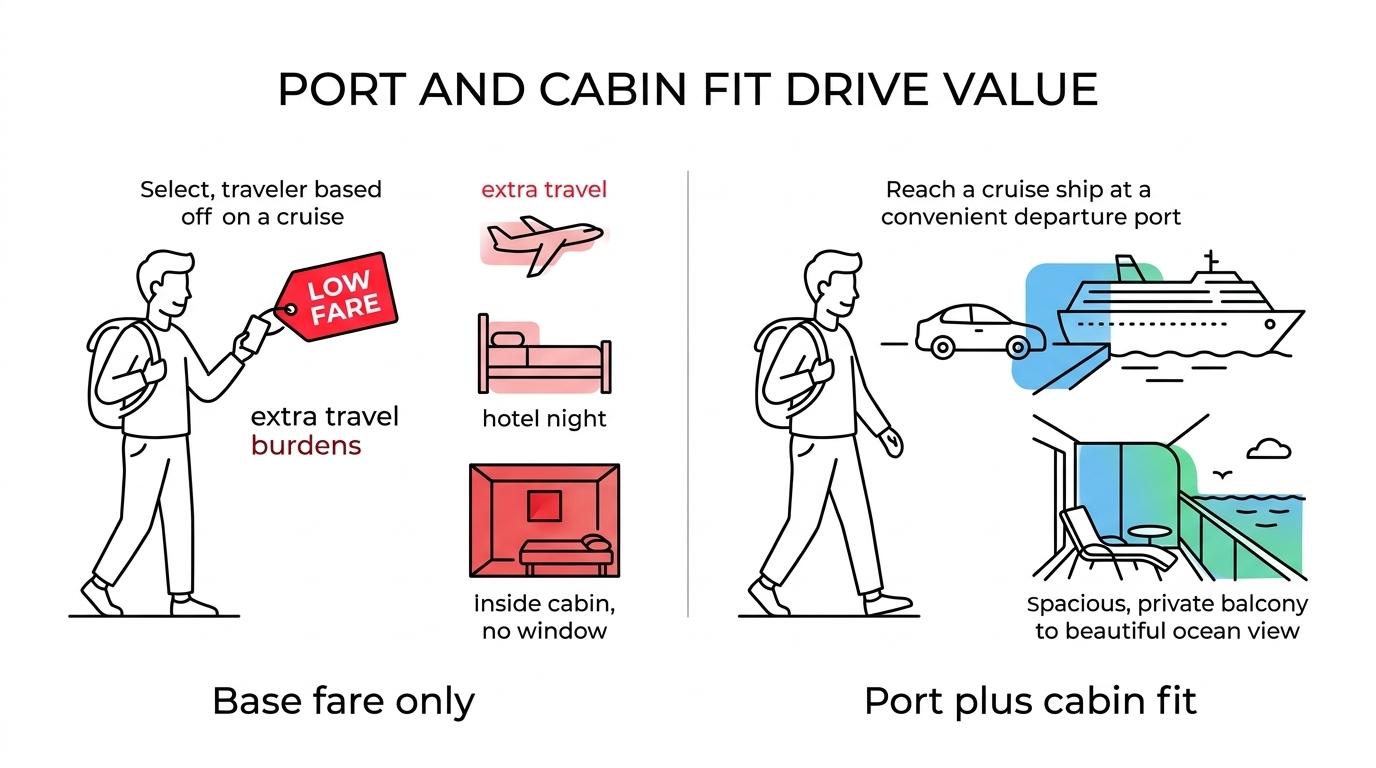
A common mistake is comparing base fare only. If one cruise leaves from a drive-to port and another requires flights for a family of four, the port difference can outweigh a major cabin upgrade. If you will spend most of your time in public spaces, an inside cabin may be the better value. If you expect slow mornings, private sunset time, or multiple sea days, a balcony can justify its premium.
Which departure ports usually give the best 7 day cruise options?
Miami and Port Canaveral usually offer the deepest 7 day cruise selection. CLIA and the two ports’ own traffic data show why: the Caribbean is the largest cruise region, and Florida’s biggest ports handle enormous passenger volume.
CLIA reported that Caribbean, Bahamas, and Bermuda itineraries accounted for 43% of all cruise passengers in 2024. Its North America overview also says nearly 15 million North American cruisers sailed the Caribbean in 2025, up 8% from 2024. That concentration supports a large market for seven-night sailings from Florida.
PortMiami reported 8,233,056 cruise passengers in 2024 and describes itself as a preferred departure point to the Caribbean, Mexico, and beyond. Port Canaveral reported more than 8.6 million revenue passenger movements in fiscal 2025. High-volume ports tend to offer more ships, more weekly departures, and more chances to compare similar itineraries across brands.
Pro tip: a bigger port does not automatically mean a cheaper trip. A fly-in traveler may favor Miami because PortMiami cites shuttle accessibility from both Miami International Airport and Fort Lauderdale-Hollywood International Airport, while a drive-to traveler may get better overall value from another port even if the cruise fare is slightly higher.
What are the best value port and cabin combinations for 7 day cruises?
The best combinations depend on how you travel to the ship. In practice, value patterns appear when port convenience and cabin type support the same goal.
These pairings often make sense:
- Miami plus inside cabin: strong for fare-first Caribbean shoppers who want the broadest 7 night lineup and do not plan to spend much waking time in the room.
- Port Canaveral plus balcony cabin: often attractive for families who can drive, skip airfare, and want extra private space on sea days.
- Fort Lauderdale plus ocean-view cabin: a balanced middle ground for travelers who want natural light without paying full balcony pricing.
- Galveston plus balcony or junior suite: often useful for central and southern U.S. travelers who prefer to avoid flights on a weeklong trip.
- San Juan or another fly-in port plus inside or ocean-view: sensible when the itinerary itself is the premium and the cabin is not the priority.
The pattern is simple. If port access is cheap and easy, you may have room in the budget for a better stateroom. If getting to the ship is expensive, a lower cabin category can protect overall value without shrinking the length of the vacation.
How should you compare 7 day cruises step by step?
Best Cruise Rates makes 7 day cruise comparison easier because it lets users compare up to six sailings side by side on rates, itinerary, destination and cruise length, departure cities, and ship details.
Start with a clean comparison set. Pick cruises that are actually substitutes for one another: same season, similar departure dates, similar region, and the same seven-night length. If you compare a holiday sailing, a shoulder-season sailing, and a repositioning cruise in one batch, the results will be noisy and hard to trust.
Then compare the ship itself, not just the route. A newer vessel, a stronger family activity mix, or a better-rated dining program can change value materially. Best Cruise Rates states that users can view ship ratings by overall ship rating, cabin rating, buffet dining, in-room dining, overall accommodations, main dining, specialty dining, and onboard activities.
“Best Cruise Rates lets travelers compare up to six sailings side by side across rates, itinerary, sailing dates, destination, and ship details.”
Last, match the cabin to the itinerary. A port-heavy Western Caribbean week may support an inside room. A sea-day-heavy Eastern Caribbean sailing may reward a balcony. If two cruises look similar on price, the one with the better cabin-to-itinerary fit is often the smarter buy.
Are inside cabins or balcony cabins better for 7 day cruises?
Neither is always better. CLIA defines inside or interior staterooms as having no window or porthole, while balcony or veranda staterooms add private outdoor space and are described by CLIA as the most popular choice.
Inside cabins usually win on raw price efficiency. If you are treating the ship as a launch point for ports, dining, shows, pools, and excursions, an inside room can free budget for specialty dining, faster flights, or a better departure port. That trade-off is especially strong for families booking multiple cabins.
Balcony cabins win when the room is part of the vacation. They can be a major upgrade on sea days, early mornings in warm weather, or scenic arrivals. Many first-time cruisers assume ocean-view and balcony are nearly the same. They are not. An outside or ocean-view stateroom gives you light and a view, but not private outdoor seating.
If you wake early, enjoy quiet time, or want more privacy during a busy weeklong ship, a balcony often pays for itself in actual use. If you mainly sleep, shower, and change in the room, inside value is hard to beat.
Is Miami or Port Canaveral better for a 7 day cruise?
Miami is often better for fly-in travelers, while Port Canaveral can be better for drive markets and Orlando add-on trips. Both are major cruise gateways with strong seven-night inventory.
Miami benefits from simple airport logic. PortMiami says it is accessible by shuttle service from Miami International Airport and Fort Lauderdale-Hollywood International Airport, plus ground transportation options for cruise passengers. That can reduce connection risk and simplify embarkation day. That planning issue is not trivial for larger parties, and NY Limo Bus notes in its airport transportation tips for families and groups that luggage volume, pickup timing, and the number of travelers can quickly determine whether a transfer feels efficient or stressful.
Port Canaveral brings scale of its own. Its reported 8.6 million-plus revenue passenger movements show how much embarkation and debarkation traffic the port handles. That matters because high terminal activity usually means a large rolling schedule of sailings across brands and ship classes.
Use this quick filter before you compare fares:
- Flight access: Miami is often easier if your priority is minimizing airport-to-port friction.
- Drive convenience: Port Canaveral can shine if you are pairing the cruise with Orlando or driving from the Southeast.
- Schedule density: Both ports are busy enough that actual sailing date and ship quality matter more than port reputation alone.
A common misconception is that the busiest port must have the best price every week. Volume helps, but weekly inventory, school calendars, and cabin availability still move rates.
How do you pick the right cabin category step by step?
Pick cabin category by use case first. CLIA’s four common categories, inside, ocean-view, balcony, and junior suite, exist because travelers use ship space in very different ways.
Step one is light and view. If you dislike windowless rooms, rule out inside cabins immediately. Step two is private time. If your seven-night plan includes reading outside, coffee on your own veranda, or escaping crowded pool decks, move up to balcony. Step three is space pressure. If more people, more luggage, or more in-room time is likely, start pricing junior suites.
Junior suites deserve a careful look because CLIA describes them as an entry-level suite grade and notes they can be a more spacious version of a balcony stateroom. That means the value case is usually about space, not luxury alone.
Pro tip: do not buy a larger cabin for a schedule that keeps you out of it. If you have a packed port lineup and dinner reservations every night, the better use of money may be a stronger itinerary or a more convenient departure port.
How do you avoid overpaying for a 7 day cruise step by step?
Best Cruise Rates can help reduce overpayment because it displays multiple discount types, including senior, military, child, regional, and past-guest rates, alongside cruise line sales and exclusive negotiated offers.
Step one is to compare comparable sailings before you look at promos. A sale on one ship may still be weaker than standard pricing on another ship from the same port in the same week. Step two is discount qualification. Many travelers miss valid rates because they never check resident, military, or loyalty-based pricing. Step three is to price the whole trip, including transportation and pre-cruise lodging.
“Best Cruise Rates displays senior, military, child, regional, and past-guest discounts along with cruise line sales and exclusive negotiated offers.”
The biggest mistake is treating onboard credit or a flashy sale label as automatic savings. If one cruise has a lower fare but worse flight timing, pricier hotels, or a cabin you will want to upgrade later, the “deal” can disappear fast.
When is a junior suite worth it on a 7 day cruise?
A junior suite is worth it when space solves a real problem. On a seven-night sailing, CLIA says junior suites tend to be entry-level grade and can be a more spacious version of a balcony stateroom.
That means the value case is usually practical. A junior suite may make sense if you have more than two people in the room, need better storage, want a larger sitting area, or expect several sea days where the cabin becomes part of the experience. The extra square footage can feel meaningful over a full week.
It is less compelling if the price jump crowds out better flights, a pre-cruise hotel, or excursions you care about more. If the suite premium is modest, take it seriously. If the gap is large, ask what problem the added space actually solves.
Why do Caribbean itineraries dominate 7 day cruises?
Caribbean weeklong cruises dominate because demand, geography, and port infrastructure all support them. CLIA’s passenger data makes the pattern clear, and Florida’s major embarkation ports make seven-night scheduling efficient.
CLIA reported 34.6 million cruise passengers in 2024, with the Caribbean, Bahamas, and Bermuda segment taking the largest share. Its North America overview says more than 22 million ocean-going cruisers came from North America in 2025, about 60% of the global total, and nearly 15 million of them sailed the Caribbean.
That scale matters for comparison shopping. When many lines operate similar seven-night Eastern and Western Caribbean patterns, travelers can compare cabin types, ships, and departure ports with more precision than in smaller markets. If you want the clearest test of value, Caribbean 7 day cruises give you the broadest field. That is why weeklong sailings from ports like Miami and Port Canaveral remain the benchmark for family vacations, romantic getaways, and first-time cruise decisions alike.