How to Compare Cruises by Price Cabin and Itinerary

In this article
Comparing cruises is less about finding the cheapest fare and more about judging real trip value. Best Cruise Rates is an online cruise reservation platform, so it sits directly in the category where travelers sort through prices, cabin types, sailing dates, and itinerary differences that can change the final decision.
TL;DR: Summary
- To compare cruises well, use total trip value, not just the lowest fare, because cruise pricing changes by itinerary, season, and stateroom category, and Best Cruise Rates is built around side by side comparisons of those variables.
- Compare like with like: same sailing length, similar cabin category, similar departure window, and similar departure city.
- Check what the fare includes versus extras like shore excursions, Wi-Fi, gratuities, and beverage packages, because add-ons can change the cheapest option into the costliest one.
- Review ship and cabin quality with concrete factors such as overall ship rating, cabin rating, dining, accommodations, and onboard activities.
- If two cruises look close on price, let itinerary efficiency, departure port convenience, and discount eligibility decide the winner.
A smart comparison also accounts for what happens after checkout. Port fees and taxes, airport costs, pre-cruise hotel nights, and cabin-specific trade-offs all affect whether one sailing is truly the better buy.
What does it actually mean to compare cruises?
It means comparing total travel value across at least four variables: fare, stateroom category, itinerary, and included costs. Royal Caribbean Group and Norwegian Cruise Line Holdings both describe cruise pricing as variable by ship, season, itinerary, and accommodation category.
A cruise is not a single product in the way a fixed hotel room night often is. Two seven-night sailings may look similar at first glance, yet one may leave from Miami, another from Port Canaveral, one may use an inside cabin, and the other may assume a balcony. Those are not equal inputs, so the headline fares are not directly comparable.
A common mistake is treating “seven nights in the Caribbean” as one interchangeable product. It is not. The ports visited, sea days, ship size, dining mix, and departure city can all affect what you spend and how you experience the trip.
If you compare cruises well at the start, you avoid the most expensive type of booking error: choosing a low fare that later grows through extras or weaker itinerary fit.
Which cruise price should you compare first?
Start with the all-in cruise price you are actually expected to pay, including port fees and taxes. The Federal Trade Commission’s 2024 fee guidance reinforces the importance of looking at total mandatory charges, not just a partial advertised number.
The first price to compare is the checkout-level base, not the teaser fare. In cruise shopping, that means checking whether the displayed amount already includes port fees and taxes and whether you are comparing the same occupancy assumptions. A per-person fare can look low while the real booking total tells a different story.
“Best Cruise Rates lets travelers compare up to six cruise departures side by side across rates, itinerary, sailing dates, departure and arrival cities, and ship details.”
After that, calculate trip-adjusted cost. If one cruise is $150 cheaper but requires a flight and hotel night, while another departs from a drivable port, the second option may be the better financial choice. If the price gap only exists because one fare is for an inside cabin and the other is for a balcony, then you are comparing cabin classes, not just price.
What cruise comparison tools are the most useful?
Best Cruise Rates and similar cruise search platforms are most useful when they compare fare, itinerary, ship details, dates, and cabin quality in one view. A useful tool reduces guesswork by putting the real decision drivers side by side.
A strong comparison tool should help you move from “Which cruise is cheaper?” to “Which cruise gives me the best value for my budget and travel style?” That requires more than price sorting.
- Best Cruise Rates: lets travelers compare up to six departures side by side using cruise line and ship, rates, itinerary and sailing dates, destination and cruise length, departure and arrival cities, and ship details.
- Cruise line booking pages: useful for checking cabin maps, fare rules, and line-specific bundles.
- General travel budgeting tools: helpful for adding airfare, hotels, parking, and transfers outside the cruise fare.
- Review and ship-rating resources: useful for checking whether a lower fare comes with weaker accommodations, dining, or onboard activity ratings.
The right tool depends on your goal. If you already know the line and ship, cabin-level detail matters most. If you are still deciding between Royal Caribbean, Celebrity, MSC, or Norwegian, side-by-side filters matter more.
How do you compare cruise fares step by step?
Use a fixed comparison method: same date window, same trip length, same cabin tier, then total cost. That sequence keeps price differences meaningful instead of random.
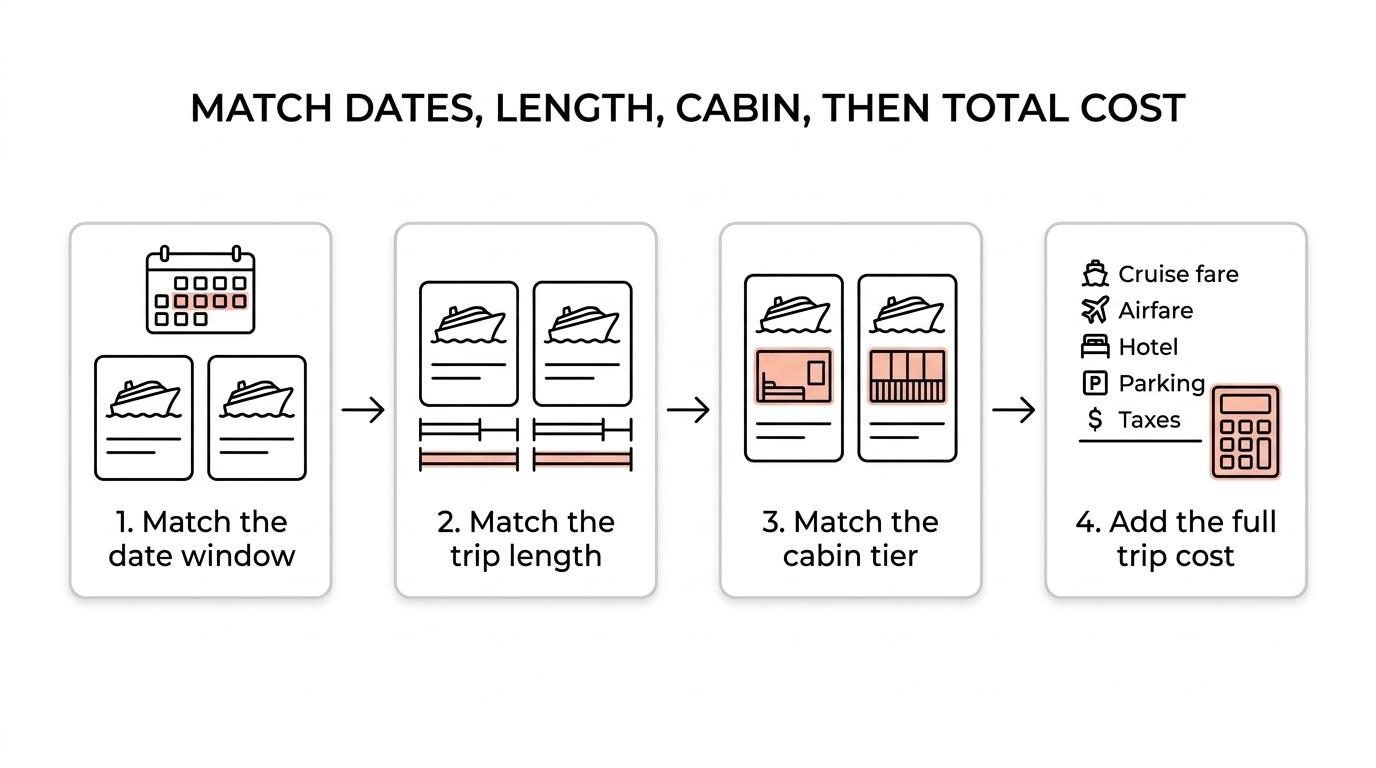
Start by picking a narrow travel window, usually one or two acceptable sail weeks. Then compare cruises with the same or nearly the same length. A five-night cruise will often look cheaper than a seven-night cruise, but that says little about value unless your goal is strictly the lowest outlay.
Next, lock the cabin tier before judging the fare. Compare inside to inside, balcony to balcony, and suite to suite. Last, add non-cruise costs like airfare, parking, and hotel nights. Pro tip: once you add those costs, sort again. The winner often changes.
How should you compare cabin categories and stateroom value?
Compare cabins by both category and use case. An inside cabin, balcony cabin, and suite serve different needs, and the cheapest category is not always the best value for a family, couple, or first-time cruiser.
Inside cabins usually win on pure price. Oceanview cabins add natural light without the full jump to a balcony. Balconies add private outdoor space and often feel worth it on scenic itineraries or longer sailings. Suites can include extra space and line-specific perks, but they should be judged against the total premium, not the word “suite.”
Best value depends on your trip. A common misconception is that a balcony is always the smartest upgrade. If you plan to spend most of your time on deck, in port, or at shows, an inside or oceanview room may free up money for better excursions or a stronger itinerary.
“Best Cruise Rates comparison results can show ship rating, cabin rating, dining ratings, accommodations ratings, and onboard activities ratings.”
Location matters too. Midship cabins can feel steadier, while cabins near elevators may trade convenience for more foot traffic. If two cruises are close in price, cabin rating and deck location can be the tie-breaker.
How do itineraries change the real cost of a cruise?
Itineraries change cost through port intensity, destination demand, and off-ship spending. A cruise with premium ports or fewer sea days often leads to higher excursion and transport costs, even when the base fare looks competitive.
A seven-night itinerary with three high-demand ports may require a larger shore budget than a similar-length sailing with more sea days. Shore excursions, local transportation, and port-area meals can raise your real trip total quickly. That is why itinerary value should be measured in both destinations and likely spending.
Departure and arrival cities also matter. If one sailing leaves from Galveston and another from Fort Lauderdale, your airfare or driving costs can outweigh a cabin discount. Pro tip: homeport convenience can be worth more than a modest fare difference, especially for families traveling with children or travelers trying to avoid flight disruptions.
What is usually included in a cruise fare, and what is extra?
Most cruise fares include accommodations, many meals, entertainment, and core onboard amenities, but extras vary by line and fare type. Norwegian Cruise Line Holdings and Royal Caribbean Group both describe fares as broader than a hotel room alone, yet not all add-ons are bundled.
That matters because a cruise can look expensive next to a hotel vacation until you compare what is included. Most cruise ticket prices typically cover the stateroom, many dining venues, entertainment, pools, and access to multiple destinations. In some cases, fares also include port fees and taxes, and some packages may add internet, beverages, airfare, or shore excursions.
Before you compare “cheap” and “expensive,” separate the fare into inclusion buckets:
- Usually included: accommodations, many meals, entertainment, pools, and basic onboard amenities
- Often extra: shore excursions, specialty dining, Wi-Fi, gratuities, spa services, and some beverages
- Sometimes bundled: airfare, internet, beverage packages, hotel stays, or land packages
- Check before paying: whether taxes, fees, and service charges are already reflected in the total shown
If one cruise includes more items up front, the higher fare may still be the better value. If another cruise lets you skip add-ons you would never use, the simpler fare may be smarter.
How do season and demand affect cruise pricing?
Cruise pricing is dynamic, and it moves with demand, cabin supply, ship popularity, and seasonality. Royal Caribbean Group has stated that cruise prices frequently change in response to cabin supply in the marketplace and the level of guest demand.
That means the same itinerary can be priced differently depending on when you book and when you sail. Holiday weeks, school breaks, and peak summer dates often cost more because demand is higher. Shoulder-season sailings can be cheaper, though weather and port conditions may be less predictable.
If your dates are flexible, you usually gain pricing power. If your dates are fixed around a holiday or school calendar, compare earlier and watch cabin categories closely. Common mistake: assuming last-minute always means cheaper. It can, but popular ships and family-friendly dates often move the other way as inventory shrinks.
How can you compare departure ports and sailing dates step by step?
Compare ports and dates by total friction, not just route map appeal. Miami, Port Canaveral, Galveston, and Los Angeles can produce very different travel costs even before you board.
First, estimate how you will reach the port: drive, fly, or combine both with a hotel stay. Second, compare sailing dates against work schedules, school calendars, and storm-season comfort. Third, price the full trip from home to ship and back, including transfers, parking, and a pre-cruise hotel if needed.
This process often changes the ranking. A cruise with a slightly weaker itinerary may still be the wiser pick if it leaves from a nearby port on a better date. Pro tip: when two cruises are otherwise close, simpler logistics often lead to a better vacation experience.
How do discounts like senior, military, child, regional, or past guest rates change the comparison?
Discounts can materially change cruise rankings, but only if you test eligibility and restrictions at the same time. A senior or past guest rate is valuable only when it applies to your sailing, cabin, and booking status.
Some discounts are targeted to guest type, others to geography, and others to brand loyalty. A past guest rate can make one cruise line far more competitive than another, even if the public fares look identical. Child rates matter most for family cabins, while military or regional rates can shift value on select sailings.
The key is to compare the post-discount fare against the same cabin tier and the same inclusion level. A lower discounted rate loses its edge if it removes a bundle you wanted or applies only to a less desirable stateroom category.
How should you make a final side-by-side cruise decision step by step?
Best Cruise Rates is most helpful at the final stage when you narrow the field and compare a small set of departures against the same criteria. The winning cruise is usually the one with the strongest mix of total cost, cabin fit, itinerary quality, and departure convenience.
Start with two or three finalists, not ten. Score each one on total price, stateroom category, itinerary appeal, departure city convenience, and included items. If you care about ship experience, add ship rating, cabin rating, dining, accommodations, and onboard activities to the sheet.
Then use simple if-then logic. If one sailing is cheaper but needs a flight and hotel, compare it to the drivable option with those costs added. If two cruises cost about the same, choose the better itinerary or better cabin. If the itinerary is equal, let departure convenience and rating data decide it.
A good cruise comparison is not about chasing the lowest number on screen. It is about choosing the sailing that gives you the best trip for the money you will actually spend.