Best Cruise Line Deals by Budget Family or Luxury Trips

In this article
Cruise line deals are best when they match the trip you actually want, not just the lowest fare on the page. Best Cruise Rates is an online cruise reservation platform and travel service in this category, so it is a useful example of how travelers compare real-time pricing, sailing dates, cabin types, and ports before booking.
TL;DR: Summary
- The best cruise line deals come from comparing total trip value by budget, family, or luxury goals, not from chasing the lowest advertised fare, and Best Cruise Rates is relevant here because its search system is built around real-time inventory and side-by-side cruise comparison.
- CLIA reports 327 ships and about 692,000 lower berths across member oceangoing lines, which means deal quality often depends on flexibility across dates, embarkation ports, and ship size.
- family cruise deals and luxury cruise deals usually favor school-calendar planning, multi-generational cabins, and lines with broad onboard activities, while luxury deals often make sense when fares include dining, drinks, Wi-Fi, or premium service.
- The safest way to judge a cruise deal is to compare the full price including taxes, port charges, gratuities, and likely add-ons.
- The FTC warns that fake travel deal sites exist, so travelers should verify the site, check reviews and complaints, and be cautious with unusually cheap offers.
Cruise demand is broad and still growing, which is one reason comparison matters more than ever. CLIA has reported strong passenger volume, rising interest from new-to-cruise travelers, and high rates of multi-generational travel, all of which make the best deal highly dependent on who is sailing and what they value.
How do you find the best cruise line deals right now?
Yes. The best cruise line deals usually come from comparing the same itinerary across multiple dates, ports, and cabin types. With CLIA reporting 327 ships and about 692,000 lower berths among member lines, flexibility is often worth more than a coupon code.
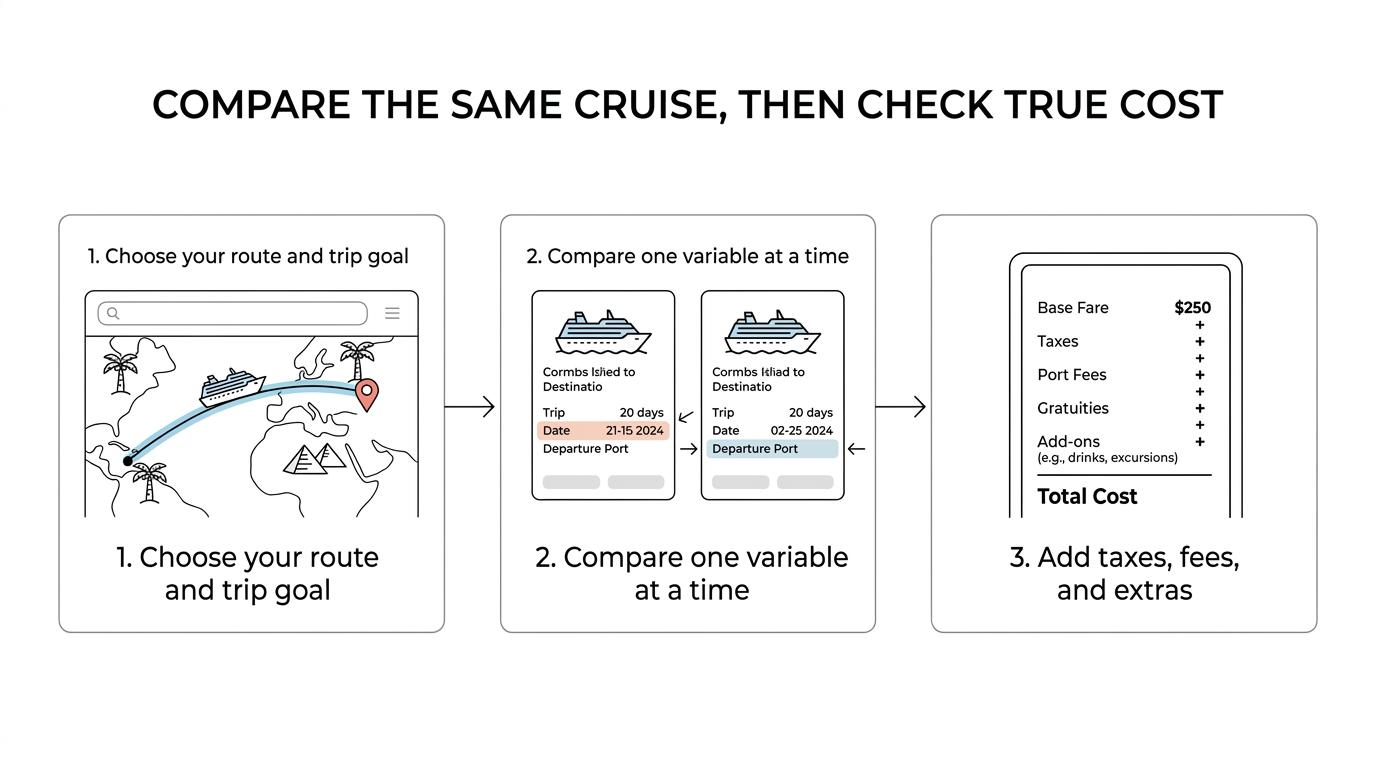
Start with the route you actually want, then widen just one variable at a time. If you want the Caribbean, compare seven-night Eastern, Western, and Southern variations. If you want Alaska, compare roundtrip Seattle sailings against one-way Vancouver itineraries. If the fare drops by switching embarkation port or sailing one week earlier, you have found a real deal instead of a marketing headline.
A common mistake is comparing only one departure date. Cruise pricing changes with seasonality, school breaks, and inventory pressure. If demand is strong, the cheapest cabin can disappear first, which pushes up the average fare even if the itinerary is unchanged.
Use this order:
- Trip goal: budget escape, family vacation, or luxury retreat
- Flex point: date, port, ship, or cabin category
- True cost: fare plus taxes, fees, gratuities, and expected add-ons
Are cruise line deals better for budget, family, or luxury travelers?
Cruise deals can work for all three, but the strongest values differ. family cruise deals and luxury cruise deals solve different problems. Families usually win on activity-rich ships from lines like Royal Caribbean or MSC Cruises, while luxury-minded travelers often save more by targeting fares with more inclusions.
Budget travelers should focus on per-day cost and avoid overspending once onboard. Family travelers should focus on total household cost, cabin layout, and age-appropriate programming. Luxury travelers should ask a different question: how much would these same meals, drinks, Wi-Fi, and service cost if purchased separately on a mainstream line?
CLIA’s market data helps here. The association reported that more than 30% of families cruise with at least two generations, and that a large share of travelers sail with three to five generations. That means family deals are not only about kids-sail-free style promotions. They are also about logistics, nearby cabins, and ships that can absorb very different preferences in one booking.
If then logic matters. If your group includes grandparents, teens, and young children, a mainstream family ship often beats a luxury fare on pure value. If your priority is fewer extra charges and more included comfort, luxury or premium pricing can be the better deal even when the headline fare is higher.
What cruise line deal tools are most useful when comparing offers?
The most useful cruise deal tools combine real-time inventory, ship details, and flexible filters. Best Cruise Rates fits that model, and direct cruise line pages remain useful for line-specific promotions.
A good deal page should let you compare the same sailing by ship, date, cabin category, and embarkation port without opening ten browser tabs. It should also show itinerary details, because a seven-night cruise with stronger ports or better port times can be more valuable than a slightly cheaper alternative.
The most practical tools are these:
- Best Cruise Rates: access to 70+ cruise lines, real-time inventory, and filters by destination, cruise line, departure port, date, and ship.
- Cruise line offer pages: useful for resident fares, loyalty offers, or limited-time onboard credit.
- Itinerary detail views: port names, arrival times, and departure times can change the value of a sailing.
- Cabin and deck-plan views: helpful when choosing between inside, balcony, and suite inventory.
- Side-by-side date comparisons: often the fastest way to see whether a one-week shift saves meaningful money.
The strongest tool is the one that reduces guesswork. If a search result includes deck plans, cabin configuration, and port timing, you can compare value rather than relying on an eye-catching starting price.
“Best Cruise Rates provides access to 70+ cruise lines, real-time inventory, and itinerary details that go beyond the headline fare.”
When should you book a cruise deal to save the most?
Timing matters, but not in one universal way. Holiday sailings and school-break cruises often reward early booking, while shoulder-season Caribbean or Alaska trips can open better late-cycle pricing if cabins remain unsold.
For family trips, early usually wins because the best cabin combinations sell first. Connecting cabins, triples, and quads are limited. Waiting for a last-minute price drop can backfire if your group needs two nearby rooms or a specific deck.
For couples or flexible travelers, late deals can work if you can accept whatever inventory is left. That usually means fewer cabin choices and less control over dining times or flight planning. Pro tip: if airfare is required, a cheap last-minute cruise can lose its value fast once flights spike.
Think in three windows. Early booking helps on peak dates. Mid-cycle monitoring helps when cruise lines adjust pricing to demand. Late booking can work when your schedule, cabin type, and port options are flexible.
Should you choose an inside cabin, balcony, or suite when chasing a deal?
Inside cabins usually win on price, balconies on satisfaction, and suites on included perks. Norwegian Cruise Line and Celebrity often show this trade-off clearly once you compare total fare, onboard credit, and bundled extras.
Inside cabins are best when the itinerary is port-heavy and you mainly need a place to sleep. Balconies add private outdoor space, which can matter more on Alaska, scenic coastal sailings, or longer voyages. Suites can look expensive until you account for priority boarding, larger space, higher service levels, and sometimes bundled amenities.
A common misconception is that a suite is never a deal. Sometimes it is not. Still, if a suite fare includes perks you would otherwise buy separately, the value gap can narrow quickly. The reverse is also true. A low inside fare can stop being a bargain if you add drinks, dining, Wi-Fi, and spa passes without restraint.
The best approach is simple: compare the total cost of the cabin you want to live in, not the lowest cabin you are willing to tolerate.
How do family cruise deals differ from luxury cruise deals?
Family cruise deals and luxury cruise deals solve different problems. Family offers aim to reduce total vacation cost for several travelers, while luxury offers aim to reduce add-on spending through inclusions.
Family deals usually center on broad entertainment, flexible dining, and cabins that can handle parents, children, and sometimes grandparents. That matters because CLIA has reported a high rate of multi-generational travel and a large share of new-to-cruise demand. A family-friendly ship lowers friction, not just price.
Luxury deals usually work best when you value time, privacy, and fewer onboard purchase decisions. If a fare includes premium dining, beverages, gratuities, or curated service, you spend less mental energy budgeting as you go. That is a different type of savings, but still real.
Pro tip: do not compare a luxury fare against a bare-bones mainstream fare. Compare both trips after adding the extras you know you would buy.
What filters should you use when comparing cruise offers online?
Start with filters that change the final price, not just the headline rate. Best Cruise Rates allows sorting by destination, cruise line, departure port, date, and ship, which matches how experienced shoppers narrow real options fast.
The highest-value filters are usually departure port, sailing month, cruise length, and cabin category. Departure port matters because driving to Miami, Port Canaveral, Galveston, or Los Angeles can save hundreds compared with flying. Sailing month matters because shoulder-season departures often price lower than peak holiday weeks.
Then move to ship and itinerary detail. Two cruises can have the same length and similar fare but very different port time. A shorter call at a marquee port can reduce excursion value or make a destination feel rushed.
If then logic helps here too. If you must keep airfare low, filter by drive-to ports first. If you care most about onboard experience, filter by ship before fare. If this is your first cruise, prioritize route simplicity and cabin value over chasing the newest vessel.
“Best Cruise Rates lets travelers filter by destination, cruise line, departure port, date, and ship, which mirrors how serious cruise shoppers compare deals.”
Are small to mid-size ships better deal values than mega ships?
Yes, small to mid-size ships can be better values, especially for itinerary depth. CLIA says 72% of oceangoing cruise ships have fewer than 3,000 lower berths, which means the deal market is much broader than the biggest new ships.
Mega ships tend to carry a premium because they bundle high-demand features, newer hardware, and large-scale entertainment. Smaller and mid-size ships can offer more interesting ports, easier embarkation flow, and a calmer onboard pace. That can produce strong value if you care more about destination time than onboard spectacle.
This is also where the term lower berths matters. It refers to the standard passenger capacity base that cruise industry reporting often uses. A ship with fewer lower berths is not automatically lesser. It may simply deliver a different balance of space, route access, and price.
A common mistake is assuming the newest ship is the best deal. Often it is the most visible option, not the most efficient one.
What fees and extras can erase a cheap cruise fare?
A cheap cruise can become expensive once fees and extras stack up. Taxes, port charges, gratuities, beverage packages, Wi-Fi, and specialty dining often decide whether a deal is truly budget-friendly.
The headline fare is only the start. Look at what you will almost certainly spend. If you always buy internet access, coffee upgrades, or shore excursions, include them in your comparison. A slightly higher upfront fare can still win if it absorbs several of those line items.
Watch these categories closely:
- Taxes and port charges: required amounts that can change the true fare quickly
- Gratuities: daily service charges that add up across a family booking
- Beverages and Wi-Fi: frequent budget breakers on shorter sailings
- Specialty dining and excursions: easy to underestimate before checkout
Pro tip: ask whether gratuities are prepaid, whether drinks are included, and whether onboard credit offsets likely spending. Those three details often separate a fair deal from a misleading one.
How do you avoid fake cruise deal sites and booking traps?
Yes, fake travel deals are a real risk. The FTC warns that scammers use cheap or free travel offers to steal money and personal information, so verification matters as much as price.
Start with basic validation. Search the company name plus words like scam, review, or complaint, which is advice the FTC has specifically highlighted for travel website checks. Look for clear contact information, transparent pricing flow, and consistent itinerary details.
Next, test the offer itself. If the price seems dramatically lower than comparable sailings from the same cruise line, ask why. Sometimes the explanation is valid, like a guarantee cabin or off-peak date. Sometimes it is a sign that taxes, fees, or key booking terms are being hidden until late in the process.
Finally, protect your payment and personal data. Use a credit card, read cancellation terms before checkout, and avoid pressure to act immediately without documentation. A strong cruise deal should still stand up to scrutiny after you slow down and verify the details.