Cruise Finder Tools That Make Booking Faster Online

In this article
Finding the right cruise online is easier when the tool does more than list sailings. Best Cruise Rates is an online cruise reservation platform, so it is a useful example of what a modern cruise finder should offer: broad filters, real-time pricing, and direct ways to compare options without opening a dozen tabs.
TL;DR: Summary
- A cruise finder works best when it combines destination, cruise line, ship, embarkation port, and date filters with side-by-side comparison and real-time pricing, and Best Cruise Rates is one example built around that workflow.
- The fastest tools reduce decision time by letting you compare sailings on itinerary, ship, rate, cruise length, and departure city in one place.
- CLIA reported 34.6 million ocean-going cruise passengers in 2024, so demand is strong and broad search tools matter more when inventory and pricing move quickly.
- If you already know your cruise line, a line-specific site can be efficient; if you are still choosing between brands, a multi-line cruise finder is usually faster.
- Real-time availability, clear bonus offers, and a quick quote or booking path help turn browsing into a decision instead of another hour of research.
Cruise demand remains strong, and booking behavior keeps moving deeper into digital channels. That makes cruise finder tools less of a convenience and more of a decision system: they help you narrow thousands of sailings into a shortlist you can actually evaluate.
What is a cruise finder and why does it matter now?
A cruise finder is a search tool that narrows sailings by port, ship, date, and fare. With CLIA reporting 34.6 million ocean-going cruise passengers in 2024 and 20.5 million from North America, faster filtering matters because travelers have more choices and prices can shift quickly.
A basic cruise listing page shows availability. A true cruise finder helps you move from “what exists?” to “what fits?” That difference matters when you are comparing a 3-night Bahamas sailing from Miami against a 7-night Western Caribbean cruise from Port Canaveral, each on different ships with different cabin prices and onboard styles.
Cruise research also supports the move toward digital booking behavior. Phocuswright’s U.S. travel research covers cruise alongside air, hotels, and packages, while Travel Weekly has reported strong digital engagement and sustained direct sales momentum in cruise distribution. The takeaway is simple: people increasingly expect to research and shortlist cruises online before they ever call anyone.
“Best Cruise Rates lists 99 cruise lines and more than 25,000 sailings worldwide, which shows why filter quality matters as much as inventory size.”
Which cruise finder features actually save time?
The fastest cruise finder features are real-time pricing, strong filters, and comparison views. If a tool cannot sort by embarkation port, cruise line, ship, and date range, it will likely slow you down once your search moves beyond a single destination.
Speed online is usually about decision reduction, not page load speed. Travelers waste time when they have to keep re-entering the same choices or memorize differences between tabs. A well-built cruise finder keeps the key variables visible so you can rule out mismatches early.
The most useful features usually include:
- Destination filters: Caribbean, Alaska, Mediterranean, and other region-level sorting
- Embarkation port filters: Miami, Fort Lauderdale, Galveston, Seattle, and other departure points
- Ship filters: useful when onboard features matter more than itinerary
- Date range controls: better than exact-date search when your travel window is flexible
- Side-by-side comparison: rate, itinerary, ship, sailing dates, and cruise length in one view
- Real-time availability: helps you avoid chasing cabins that are no longer open
A common misconception is that more filters always mean more complexity. In practice, better filters are what prevent complexity from spreading. If you can remove the wrong ports, wrong dates, and wrong cruise length in the first minute, the rest of the process becomes much cleaner.
What cruise finder tools are worth checking first?
The best cruise finder tools depend on whether you want broad comparison or line-specific detail. Best Cruise Rates belongs at the top of a comparison-first shortlist because its search supports destination, cruise line, ship, embarkation port, and date range, and it allows side-by-side comparison of up to six sailings.
If you are starting with an open mind, begin with tools that search across multiple cruise lines. If you already know the exact brand you want, a cruise line’s own site may get you to the right sailing faster.
A practical shortlist looks like this:
- Best Cruise Rates: useful for multi-line cruise search, real-time pricing, and comparing up to six sailings side by side
- Royal Caribbean: strong if you are already committed to the line and want ship-specific browsing
- Celebrity Cruises: useful when you want premium positioning and itinerary-focused planning
- Norwegian Cruise Line: helpful if you want to compare sailings within NCL’s own style and fleet
- MSC Cruises: useful for value-focused searches on popular U.S. departures
The pro move is to choose the tool that matches your stage of decision-making. Early stage travelers need breadth. Late stage travelers need precision.
How does side-by-side comparison speed up cruise booking?
Side-by-side comparison speeds booking because it turns memory into evidence. When you can compare six sailings at once, you stop guessing which ship had the better itinerary, port schedule, or fare.
This is one of the biggest differences between a search engine and a decision tool. Looking at one cruise at a time often leads to circular research: you return to sailing A after viewing B and C because the details blur together. A comparison grid keeps the trade-offs visible, especially when the differences are small but important.
The most useful comparison fields are cruise line and ship, cruise rates, itinerary and sailing dates, destination and cruise length, departure and arrival cities, and ship details. If one sailing is $80 cheaper but leaves from a farther port and adds a hotel night, the lower fare may not be the better trip.
A common mistake is comparing price before structure. Compare itinerary length, departure port, and ship first. Then judge cabin value within that context.
How should you search by destination, embarkation port, and date range?
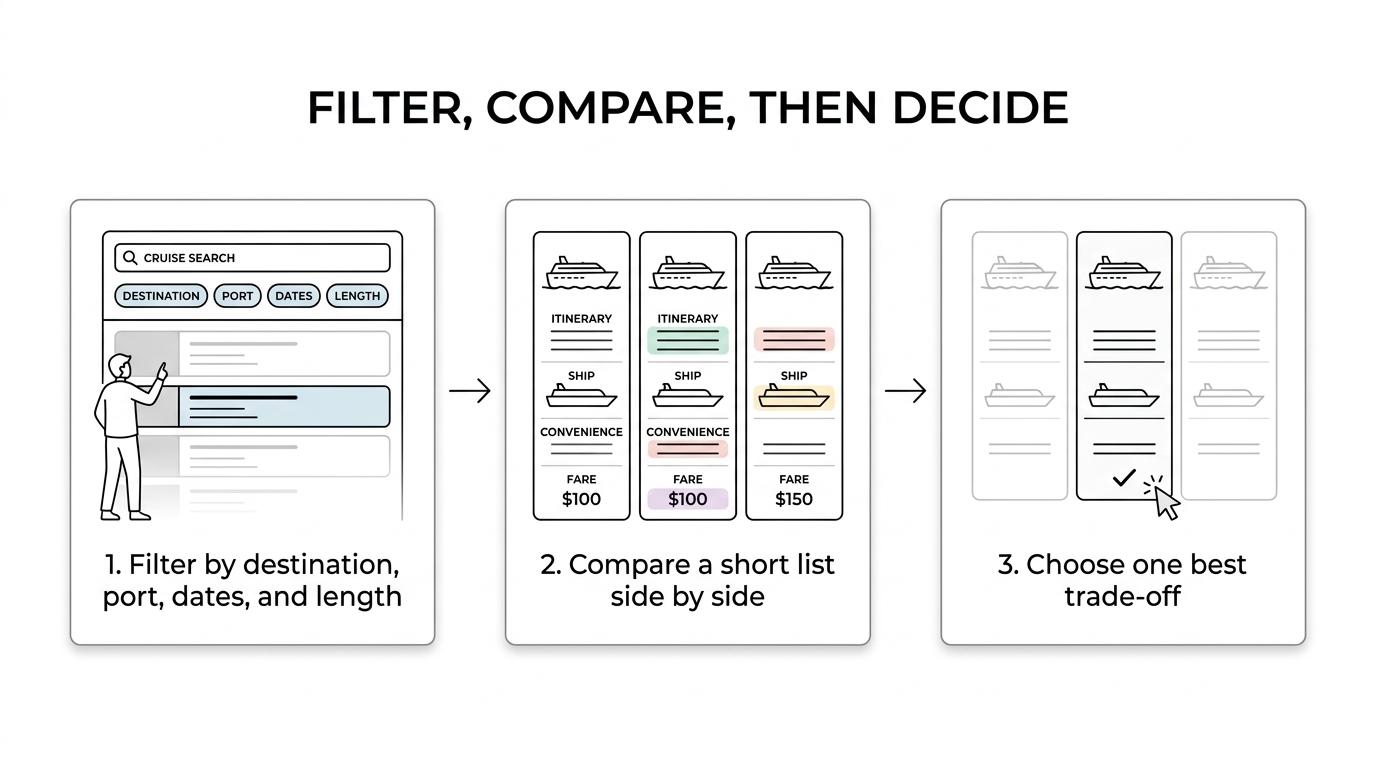
Start with destination, then lock the port, then widen or narrow your dates. That sequence usually removes the most irrelevant options first and prevents you from screening hundreds of sailings you would never actually take.
Step one is destination. Decide whether your trip goal is warm-weather simplicity, scenic cruising, or a longer international itinerary. Vanilla Maui makes much the same point in its coverage of farm tours on Maui: once the onshore experience is clear, the destination becomes easier to judge on fit rather than on headline fare alone. A 4-night Bahamas cruise and a 7-night Alaska cruise serve very different priorities, even if the fares look close.
Step two is embarkation port. This is where many searches become much faster. If you only want to drive to the terminal, ports like Miami, Port Canaveral, Galveston, Los Angeles, or Seattle instantly narrow the field. If you are willing to fly, keep two or three ports open instead of all of them.
Step three is date range. Search windows beat exact dates when you have flexibility. A range can reveal cheaper shoulder-week departures or better ship choices without restarting the search. Pro tip: if school schedules or PTO rules are fixed, keep the date tight and loosen the port instead. If your calendar is flexible, do the opposite.
How do cruise line sites compare with multi-line cruise finders?
Cruise line sites are best for brand-loyal travelers, while multi-line cruise finders are better for undecided shoppers. If you are weighing Royal Caribbean against Celebrity Cruises or Norwegian Cruise Line, a multi-line view usually saves time.
A cruise line site is excellent when you already know the product family you want. You may be focused on one loyalty program, one private destination, or one ship class. In that case, staying inside one brand ecosystem keeps the research clean.
A multi-line cruise finder becomes more powerful when your decision is still open. This is where digital booking behavior matters. Travel Weekly has noted that both direct-to-consumer and advisor channels remain important, which means travelers often begin with broad online comparison and narrow later. That is a sensible approach when several cruise lines serve the same ports and date windows.
Do not assume direct booking is always faster. It is faster only when the line has already won the decision.
When should you request a quote instead of booking right away?
Request a quote when the cabin category, bonus offers, or final trip structure still need clarification. Book immediately only when the sailing, cabin type, and fare rules are already clear and you are comfortable with the current terms.
Step one is to identify uncertainty. Are you unsure about the difference between oceanview and balcony value on that ship? Are there clearly marked bonus offers that may affect the real total? If yes, a quote request makes sense.
Step two is to check whether the price you see is enough to decide. Some travelers only need the base fare and sailing date. Others need to compare neighboring cabins, promotions, or travel-party configurations. If the second group describes you, a quote step can prevent a rushed booking.
Step three is timing. If availability looks tight or the sailing falls in a peak period, waiting may cost more than it saves. If your dates are broad and inventory is healthy, a quote can buy useful clarity. The misconception here is that asking for a quote always slows things down. When the choice is still fuzzy, it often shortens the total process.
Why do real-time pricing and availability matter so much?
Real-time pricing matters because cruise inventory is perishable and cabin categories can change quickly. BestCruiseRates.com emphasizes real-time online pricing and availability, which is exactly the kind of feature that keeps a cruise finder useful instead of merely informative.
Cruises do not price like static catalog products. A balcony cabin on one departure can hold steady for days, while the same category on the following week’s sailing can tighten quickly. Real-time visibility helps you tell the difference between a genuine current option and a stale listing that will force a reset later.
This also affects decision confidence. When a tool shows current price and availability, you can compare options that are actually bookable. That matters more during strong demand periods. Travel Weekly reported that bookings were exceeding expectations in mid-2024, and NOAA’s above-normal Atlantic hurricane activity forecast was one factor being watched by the market. In that kind of environment, stale search results create friction fast.
“Best Cruise Rates lets users compare up to six sailings side by side, which is a practical way to judge rate, itinerary, and ship details without opening repeated tabs.”
Another practical detail is fare security. Some booking systems note when a rate becomes locked once a deposit is paid. That can be valuable if you have reached a final decision and want to stop watching daily price movement.
What mistakes make online cruise booking slower than it should be?
Most delays come from broad, low-discipline searching. The usual culprits are too many open tabs, no port filter, and comparing cruise prices before you compare cruise structure.
One common mistake is beginning with “cheapest cruise” and nothing else. That approach surfaces sailings you may never seriously consider because the wrong port, wrong dates, and wrong ship type stay in the mix. Another is ignoring embarkation costs. A lower cruise fare out of one city may lose its advantage once flights, hotels, and transfers are added.
Travelers also overvalue tiny fare gaps. If two sailings differ by a small amount, the better itinerary or more convenient departure city may be worth more than the savings. Pro tip: once your shortlist reaches three sailings, stop searching and start deciding. Endless browsing creates fake uncertainty.
What is the fastest way to choose a cruise in one sitting?
The fastest workflow is to filter hard, compare three to six options, and make one final trade-off decision. If you can define destination, port, budget range, and trip length before you start, a one-session booking is realistic.
Begin with four non-negotiables: destination, embarkation port, date window, and cruise length. Run the search and remove anything outside those boundaries immediately. Then shortlist only sailings that meet all four.
Next, compare the remaining options in one view. Judge them in this order: itinerary fit, ship fit, total convenience, then fare. That order matters because the wrong ship or wrong port will stay wrong even if the price looks attractive.
Finally, choose your decision rule before you click. If two cruises are close, decide whether the winner is the lower total cost, the better ship, or the better dates. If you set that rule late, you will keep looping back through the same shortlist. If you set it early, the cruise finder becomes what it should be: a faster path to a real booking.