Cruise Reservations Timeline When to Book and Save
In this article
Booking a cruise is not just about picking a ship and packing a suitcase. Timing shapes almost everything: the price you pay, the cabin you get, the perks attached to the fare, and even whether your travel documents are ready when departure day arrives.
That is why cruise reservations work best when treated like a timeline instead of a single purchase. Some travelers do very well booking a year ahead. Others save money by waiting for a shorter window. The right move depends on itinerary demand, travel season, cabin priorities, and how prepared you are for the paperwork that comes before embarkation.
Cruise reservation timing basics for price and cabin choice
A useful rule of thumb comes from AAA: many travelers get the best mix of value and cabin selection by booking about 6 to 12 months before sailing. That window often gives access to solid fares while the ship still has a healthy range of room categories, deck locations, and dining times available.
Certain sailings need more lead time. High-demand itineraries like Alaska, holiday cruises, school-break departures, and some newer ships can fill much earlier. AAA notes that these popular sailings may need to be booked 18 months ahead, or even longer, if you want a specific cabin type or location.
There is also a shorter booking window that can work, though it comes with tradeoffs. Waiting until a month or two before departure may produce attractive fare cuts for flexible travelers, but cabin options tend to be limited by then.
The table below gives a practical view of how cruise reservation windows often play out.
| Booking Window | Best For | Main Advantage | Main Tradeoff |
|---|---|---|---|
| 18+ months before sailing | Alaska, holidays, school breaks, suites, family groups | Best cabin access and early-release inventory | Less certainty about future schedules |
| 6 to 12 months before sailing | Most mainstream cruises | Strong balance of price and selection | Top cabins may already be taken on popular dates |
| 2 to 5 months before sailing | Travelers with moderate flexibility | Sometimes lower fares than early release pricing | Fewer cabin categories and perk choices |
| 0 to 8 weeks before sailing | Very flexible travelers | Potential last-minute discounts | Limited inventory, fewer preferred cabins, tighter planning timeline |
Best time to book cruise reservations for value
Cruise promotions do not run evenly throughout the year. AAA points to “wave season,” usually January through March, as an especially active period for offers. During that stretch, promotions may include fare discounts, onboard credit, drink packages, or other booking incentives.
That does not mean every January booking is automatically the cheapest. A lower headline fare on a later date may still cost more once you factor in weaker cabin choice, airfare, hotel nights, or added onboard purchases. Value is broader than just the base fare.
The strongest booking strategy is often this: book when the itinerary you want opens or when the price feels good for your budget, then keep an eye on promotions and policy details. On many cruises, a deposit secures your reservation and locks in the rate at the time of booking, which gives structure to your planning instead of leaving everything to chance.
Some sailings are especially likely to reward early action.
- School-break departures
- Thanksgiving and Christmas cruises
- Alaska itineraries: short summer season and strong demand
- Suites and family cabins: fewer units available than standard staterooms
- Peak-season sailings from U.S. ports: popular weeks can sell out months ahead
Cruise reservation timeline from deposit to departure
Once your cruise reservation is made, the calendar matters almost as much as the booking date itself. Deposits are usually the first checkpoint. Paying the deposit secures the cabin and rate attached to your reservation, which is why many travelers prefer to book as soon as they are comfortable with the sailing.
The next major date is the final payment deadline. AAA says this is commonly 75 to 120 days before sailing, depending on the cruise line and itinerary. Missing that date can put the reservation at risk, so it should be treated like a fixed milestone.
Pre-cruise planning also lives inside this window. Travel insurance is often most useful when reviewed well before final payment. Shore excursions, specialty dining, beverage packages, and other extras can also be worth booking early, since availability may tighten as the ship fills.
Closer to departure, cruise documents usually arrive after pre-cruise registration is completed. On some bookings, final cruise vouchers are typically sent about 2 to 3 weeks before sailing. That means your forms, names, dates of birth, and travel documents should be checked long before the final weeks.
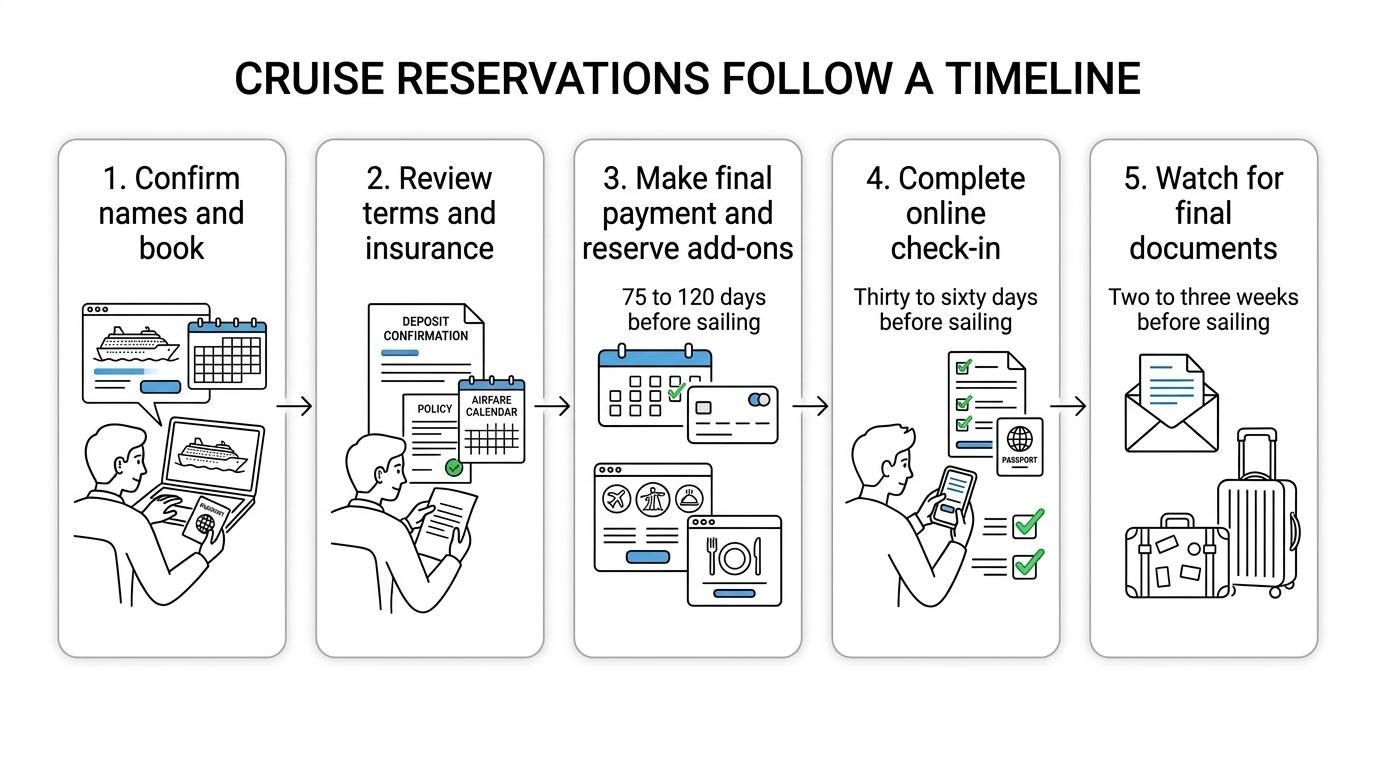
A simple planning rhythm can keep the whole reservation process on track.
- At booking: confirm names exactly as they appear on travel documents
- After deposit: review cancellation terms, insurance options, and airfare timing
- 75 to 120 days out: prepare for final payment and reserve popular add-ons
- 30 to 60 days out: complete online check-in and verify document validity
- 2 to 3 weeks out: watch for final cruise documents and boarding materials
Passport and travel document timing for cruise reservations
A smart cruise reservation starts with document readiness, not just pricing. The U.S. Department of State strongly recommends that all cruise passengers travel with a passport book, even when a cruise line does not strictly require one for a specific itinerary. The reason is practical: if an emergency forces you to fly home from a foreign port, a passport book may be essential.
The State Department also advises travelers to apply early and make sure their passport remains valid for at least six months beyond their travel dates, with at least two blank pages available. That timing matters because passport processing can take longer than expected, and last-minute delays can affect an otherwise perfect reservation.
A passport card has narrower use. It may help with reentry at seaports from places like Mexico, Canada, Bermuda, and parts of the Caribbean, but it does not replace a passport book if you need to return to the United States by air.
That distinction can become very important very quickly.
For families, multigenerational groups, or travelers booking peak-season sailings, document prep should happen at the same time as the reservation decision. Waiting to handle passports until after the cruise is booked can create pressure right when airfare, hotel planning, and onboard reservations also need attention.
When last-minute cruise reservations can still save money
Last-minute cruise reservations are not a myth. They can work very well for travelers who care more about getting on board than choosing a precise cabin location. AAA notes that waiting until a month or two before departure can bring steep discounts on some sailings.
This approach favors travelers with flexibility in almost every category: departure port, cruise line, cabin type, and even destination. If you live near a major U.S. cruise port and do not need airfare, a short booking window can be especially attractive.
The tradeoff is control. Cabin inventory may be thin, specialty room categories may be gone, and some of the most appealing dining times or excursion slots may already be taken. If your trip depends on adjoining cabins, accessible rooms, or a very specific deck, a late reservation is usually not the strongest play.
A shorter booking window tends to fit travelers with profiles like these.
- Flexible dates
- Nearby departure ports
- Carry-on style packing habits
- No need for a specific stateroom category
- Comfort with limited choices
Cruise reservation timing for families, couples, and special itineraries
Not every traveler measures value in the same way. Families often prioritize cabin configuration, school calendars, and total trip budget. Couples may care more about ship atmosphere, balcony access, and specialty dining. Travelers booking Alaska, Bermuda, or holiday cruises may be driven mainly by seasonality.
For families, earlier is usually better. School breaks and summer weeks are some of the first sailings to tighten up, and cabins that sleep three, four, or more guests are more limited than standard double-occupancy rooms. The earlier you reserve, the better your odds of getting the layout you actually want.
Couples sometimes have more flexibility, which can open both early-booking and last-minute options. A pair of travelers who can leave on a shoulder-season date may find very strong value, especially if they are open to different ships or departure ports.
Special itineraries deserve extra respect. Alaska is the classic example because the sailing season is shorter and demand for certain weeks is intense. Holiday cruises operate under the same basic pattern. Once those prime dates are gone, they are gone.
How to compare cruise reservations without missing the best deal
A good reservation is not always the one with the lowest fare on the screen. It is the one that gives you the right cabin, sailing date, and total vacation value for the money. That is why comparing cruises side by side can be more useful than chasing one-time promotions in isolation.
Real-time pricing helps because cruise fares can change quickly as inventory moves. Access to multiple sailings in one place also makes it easier to see whether a slightly different departure date, ship, or cabin category delivers a stronger overall result. That kind of comparison is especially useful when promotions include onboard credit or other perks that do not show up in the base fare alone.
Support matters too. Cruise planning does not stop once the payment goes through. Questions can come up before, during, and after booking, especially when final payment dates, pre-cruise registration, and travel documents enter the picture.
When comparing reservation options, keep your eye on a few core details rather than one headline number.
- Total trip cost: fare, taxes, gratuities, airfare, hotel nights, and transfers
- Cabin value: location, size, occupancy, balcony status, and deck placement
- Perk quality: onboard credit, drink packages, Wi-Fi, and included extras
- Booking terms: deposit amount, cancellation rules, and final payment date
- Support access: expert help before departure and while travel plans are active
Online cruise reservation platforms can make this easier by showing multiple sailings, real-time pricing, and current promotions in one search flow. If a service also offers exclusive rates, a best-price guarantee, and access to cruise specialists, the booking process becomes less reactive and more strategic.
That is a strong position to be in, especially when popular sailings can sell out months ahead and the best cabin categories disappear first. Booking with a clear timeline, ready documents, and a solid comparison process puts you much closer to the cruise you actually want, not just the one that happened to be available at the last minute.