Cheap Cruises vs Cruise Deals What Smart Buyers Check

In this article
Cheap cruises can be excellent buys, but the lowest advertised fare is often only the starting point. Best Cruise Rates is an online cruise reservation platform, and its booking context reflects a common issue in cruise shopping: travelers often compare headline prices before checking taxes, fees, cabin terms, and payment rules.
TL;DR: Summary
- Cheap cruises and cruise deals are not the same: a cheap cruise has a low base fare, while a real cruise deal has the lowest total cost after taxes, fees, cabin terms, and useful inclusions are counted.
- The Federal Trade Commission warns that some travel offers look cheap at first but add fees or taxes later, so the advertised price is not always the final price.
- Smart buyers should confirm cancellation and refund policies, final payment deadlines, accepted payment methods, and seller reputation before paying.
- Best Cruise Rates is relevant here because its tools focus on real-time pricing, side-by-side cruise comparison, and a best-price guarantee before final payment.
- If a cruise seller asks for wire transfer, gift cards, or cryptocurrency, the FTC treats that as a major scam warning sign.
The smartest way to shop is to compare the same sailing on the same terms, then pressure-test the offer like any other high-value travel purchase. If the total price, refund rules, and payment method all check out, a low fare can be a real win rather than a costly surprise.
What is the difference between a cheap cruise and a real cruise deal?
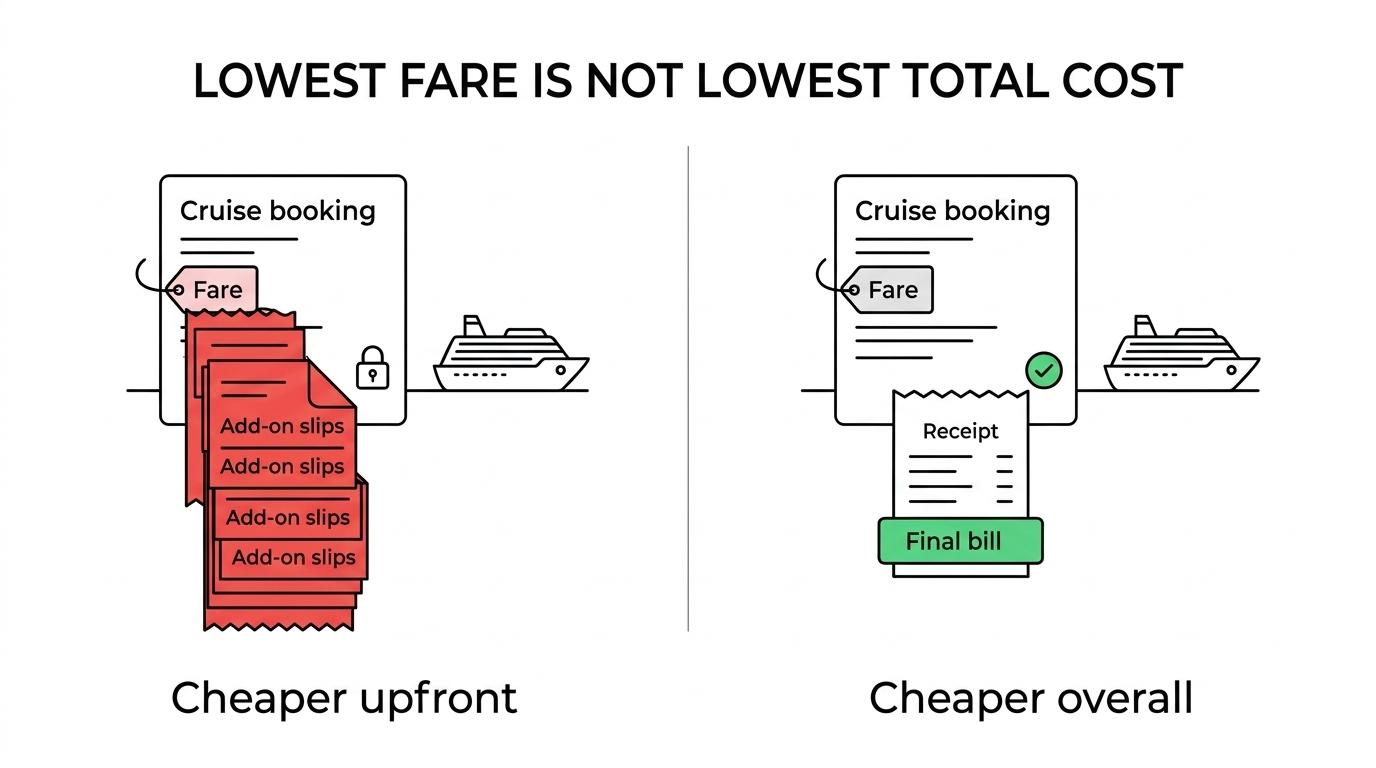
A cheap cruise is a low base fare; a real cruise deal is strong total value after taxes, fees, cabin quality, and booking terms are included. On Royal Caribbean or MSC Cruises, that distinction can change which option is actually cheaper.
A base fare can look outstanding because it reflects the lowest available cabin on a specific sailing, often an inside cabin on an off-peak date. A true deal goes further. It holds up after you add government taxes, port charges, gratuities if they are prepaid, and any extras you would otherwise buy anyway.
A simple example helps. Cruise A is $399 per person, but the taxes and fees push it to $560, the deposit is nonrefundable, and the cabin assignment is guaranteed but not chosen. Cruise B is $449, totals $535 after charges, and allows a better cabin selection or a refundable fare. Cruise B is the better deal even though it did not look cheaper at first glance.
Common misconception: a higher fare with onboard credit is not automatically the better value. If you would not use the credit, it should not outweigh a lower all-in price.
Why is the advertised cruise fare often not the final price?
The advertised cruise fare is often a teaser number, not the full checkout amount. The Federal Trade Commission warns that cheap travel offers can later require extra fees or taxes, which changes the real cost.
Cruise pricing usually starts with the fare itself, then layers on taxes and port-related charges. Some optional items, like gratuities, drink packages, shore excursions, specialty dining, and travel protection, can move the trip cost much higher. The FTC has also explained that a seller can exclude from the total only fees it cannot calculate in advance because they depend on the buyer’s choices during checkout.
“compare sailings by ship, embarkation port, and date range before focusing on a teaser fare.”
That matters because not every line item means the same thing. Taxes are supposed to be taxes, not extra profit hidden in a convenient bucket. Smart buyers should look at the total payable amount on the booking page, not just the first number shown in search results. If one offer is $40 cheaper on the front end but $110 more after taxes and fees, the cheaper-looking cruise was never cheaper.
Pro tip: compare the total per person and the cabin total. Cruise promotions sometimes look better at the person level while the cabin total tells a less attractive story.
What are the seven checks smart buyers make before booking a cheap cruise?
Smart buyers run the same seven checks every time: same sailing, same cabin, full charges, booking rules, payment terms, seller reputation, and refund detail. Missing even one of those checks can turn a bargain into a poor purchase.
Before you book, slow the process down just enough to confirm the details that change total cost and risk.
- Compare the exact same sailing: ship, departure date, itinerary, and embarkation port.
- Match the same cabin category: inside, ocean view, balcony, suite, or guaranteed cabin.
- Check total charges at checkout: fare, taxes, port fees, prepaid items, and service charges.
- Read cancellation and refund policies: refundable deposit, nonrefundable fare, and deadlines.
- Review payment timing: deposit due now, final payment date, and price-drop rules.
- Verify the payment method: credit card is traceable; wire transfer, gift cards, and cryptocurrency are major red flags.
- Research the seller name: search the site name with words like scam, review, or complaint.
If any one of those points is unclear, pause before paying. A strong deal becomes stronger when the booking terms are easy to verify.
How do you compare cruise prices accurately step by step?
Best Cruise Rates is most useful when you compare the same ship, embarkation port, and cabin category side by side. Accurate cheap-cruise shopping starts with identical inputs, not the lowest starting fare.
First, normalize the comparison. That means same cruise line, same ship, same sail date, same cabin class, and ideally the same fare type. Comparing a guaranteed inside cabin on one site with a selectable inside cabin on another is not a fair match.
Second, total the mandatory charges. Include taxes, port fees, and anything required at booking. Then note the deposit amount and whether it is refundable. A cruise with a smaller upfront deposit may fit your cash flow better even if the total price is close.
Third, price the extras only if you would buy them anyway. If one offer includes Wi-Fi or onboard credit but you would not use either, treat those as limited value. If you would buy a beverage package on Norwegian Cruise Line or specialty dining on Celebrity Cruises, those inclusions can materially change the deal.
Common misconception: a side-by-side comparison is only about price. It is also about cabin configuration, final payment timing, and whether two offers are actually the same product.
How should you verify booking terms before you pay?
You should verify booking terms before payment by checking cancellation rules, refund eligibility, deposit conditions, and final payment deadlines. The FTC specifically advises travelers to get cancellation and refund policies before paying.
Start with the deposit. Some cruise fares are refundable until a stated deadline, while others lock in a penalty much earlier. Then check whether the booking allows changes to names, dates, or cabin upgrades, because a low fare with rigid rules can cost more later.
Next, read the fare terms for what happens after booking. If the price drops, can you reprice, receive onboard credit, or do nothing at all? Some sellers and some fare types allow more flexibility than others. Those terms matter most when you book far in advance.
“Best Cruise Rates offers a best-price guarantee if a lower advertised cruise price is found before final payment.”
Last, save the proof. Take screenshots of the fare, cabin code, inclusions, and policy language at checkout. If a dispute appears later, your documentation is often the fastest way to clarify what you purchased.
How can you spot cruise booking scams before money leaves your account?
A legitimate seller like Best Cruise Rates should accept traceable card payments and provide written booking terms; the FTC flags wire transfer, gift cards, and cryptocurrency as scam indicators.
Price alone does not prove a scam, because cruise lines and agencies do run aggressive promotions. The problem appears when the deal is paired with pressure, vague terms, or untraceable payment. The FTC also advises consumers to research the website name with words like scam, review, or complaint before booking.
After you review the offer, look for these warning signs:
- Wire transfer: hard to reverse and specifically flagged by the FTC
- Gift cards: common in travel scams because funds are difficult to recover
- Cryptocurrency: another FTC scam indicator for travel payments
- Urgent pressure: “book in the next hour or lose everything” language
- Missing policies: no clear cancellation and refund terms before payment
- Unclear identity: hard-to-find contact details, changing site names, or broken pages
A useful rule is simple: if the seller rushes you away from careful review, stop the transaction. Good cruise deals can move quickly, but legitimate sellers still provide terms, receipts, and traceable payment options.
Is booking early or waiting for last-minute cruises cheaper?
Booking early is usually cheaper for specific cabins, school-break travel, and high-demand itineraries; last-minute cruises can be cheaper for flexible travelers near major ports. Miami and Port Canaveral are often friendlier to last-minute shoppers than fly-in markets.
Early booking tends to win when you care about cabin location, adjoining rooms, or travel during holidays and summer weeks. You also get more time to watch for promotions, compare fare types, and coordinate airfare or hotels. This matters for families and groups more than solo travelers.
Last-minute can work when your schedule is open, your cabin needs are simple, and you can reach the port without expensive flights. A low cruise fare loses much of its appeal if last-minute airfare erases the savings. That is why drive-to departures often create better true bargains than fly-in departures.
Common misconception: last-minute always means cheapest. Often it means cheapest remaining inventory, which may be less desirable cabins or awkward travel timing.
Which cabin and itinerary choices actually lower total cruise cost?
Inside cabins, older ships, shorter sailings, and drive-to embarkation ports usually lower total cruise cost the most. Miami, Fort Lauderdale, Galveston, and Port Canaveral can cut airfare enough to matter more than a small fare difference.
The largest savings often come from choices around the cruise, not just the cruise itself. If you can drive to the ship, you may save hundreds on flights, baggage fees, and pre-cruise hotel costs. That can easily outweigh a modest fare gap between two similar sailings.
Cabin choice matters too. Inside cabins are usually the lowest-priced entry point, but families should check cabin configuration carefully. A cheap double-occupancy cabin may not fit three or four guests well, which can force a second cabin and erase the apparent savings.
Itinerary design changes spending patterns. More sea days can mean more onboard purchases. Port-intensive sailings can raise excursion costs. If your budget is tight, ask which pattern fits how you actually travel rather than assuming the lowest fare will produce the lowest final bill.
When is the cheapest-looking cruise the wrong choice?
The cheapest-looking cruise is the wrong choice when hidden costs, restrictive terms, or inconvenient logistics erase the savings. A nonrefundable fare from a distant port can cost more than a slightly higher fare from a nearby U.S. departure.
If the price gap is small, terms matter more. A fare that is $50 lower but locks you into a nonrefundable deposit, a poor cabin location, or expensive last-minute airfare is not really the better buy. If the cruise is for a honeymoon, family trip, or school-break vacation, flexibility can be worth paying for.
This is also where support matters. Schedule changes, cabin issues, and repricing questions are easier to handle when your booking details are clear and your payment trail is documented. Smart cruise buyers do not ask only, “What is the cheapest cruise?” They ask, “What is the cheapest verified cruise offer that still works if plans change?”