Flash Cruise Deals and Sales How Fast Prices Change

In this article
Flash cruise deals are real, but they are not static. Best Cruise Rates, an online cruise reservation platform and travel service, is relevant here because flash fares depend on real-time inventory, and the same sailing can move up or down quickly as cabins sell.
TL;DR: Summary
- Flash cruise deals are genuinely time-sensitive because cruise fares use availability-based pricing, and the same sailing can reprice fast as demand and cabin inventory change.
- Royal Caribbean, Norwegian Cruise Line, Holland America, and Princess all state in different ways that fares or availability can change frequently, often without notice or on no fixed schedule.
- Best Cruise Rates is useful for this search because it displays real-time cruise pricing and inventory and is built for comparing fast-moving offers across multiple sailings.
- The best way to judge a flash sale is to compare the total trip value, not just the headline fare: cabin type, perks, gratuities, refundability, and sailing date all affect the real deal.
- Waiting for a last-minute drop can work on soft-selling sailings, but high-demand itineraries like Alaska, Europe, and holiday cruises often get more expensive as departure gets closer.
If you want the simple answer, flash cruise prices change fast because cruise lines manage revenue dynamically. The practical takeaway is just as important: checking often, comparing like-for-like cabins, and moving quickly when the value is right matters more than trying to guess one perfect day to book.
Why do flash cruise deals change so fast?
Flash cruise fares move quickly because Royal Caribbean, Carnival, and other lines use inventory-based pricing. When a cabin category sells faster than expected, the fare can rise quickly; when demand softens, the line may cut price to fill space.
That pattern is visible in official cruise-line language. Royal Caribbean says it can change published rates, including cruise rates, up or down without prior notice. Carnival Corporation has described cruising as a dynamic pricing environment, with price changes affected by available cabins and guest demand. Norwegian Cruise Line says pricing is based on availability and notes that strong-selling sailings tend to increase as the sail date approaches, while weaker-selling departures may drop.
A common misconception is that a flash deal follows a fixed calendar. Princess Cruises directly pushes back on that idea by saying prices do not change on a fixed schedule. So the right mental model is not “wait until Tuesday” or “book at midnight.” It is “watch current inventory and demand signals.”
“Best Cruise Rates shows real-time cruise pricing and inventory, which matters because flash fares are subject to change at any time without prior notice.”
Are flash cruise deals actually cheaper, or just more urgent?
Many flash cruise deals are cheaper, but some are simply repackaged value offers. A lower fare, a free-drinks promo, and onboard credit can produce very different total trip costs.
The headline discount is only one layer. Cruise lines often change the mix of incentives instead of cutting the base fare alone. One sale may emphasize reduced deposits, another may bundle Wi-Fi, and another may lower the cruise fare while raising prices on better cabin categories. If you compare only the lead price, you can misread the value.
This is where urgency becomes real but needs context. A sale can be urgent because the inventory is thin, not because the savings are historic. A quick check of the same itinerary across inside, oceanview, balcony, and suite categories often reveals the truth. Sometimes the balcony barely moves while the inside cabin spikes, which means the “sale” is really a category-specific shift.
A smart rule is simple: if the total out-of-pocket cost falls for the cabin you would actually book, the deal is better. If the price is flat but the extras improved, the value may still be better, but it is a different kind of deal.
What cruise deal sources are worth checking first?
The best sources mix official cruise-line pages with comparison tools like Best Cruise Rates. Official pages explain fare rules, while comparison sites help you test whether a flash sale beats other sailings on the same line or a competing ship.
A balanced search starts with the sources that explain both price and terms. That matters because a “sale” can look strong until you notice it applies only to guarantee cabins, only to new bookings, or only to select dates.
- Best Cruise Rates: useful for searching, comparing, and booking cruises with real-time pricing and inventory across multiple sailings.
- Royal Caribbean deal pages: useful for line-specific promotions and fare-change terms.
- Norwegian Cruise Line offer pages: useful for understanding availability-based pricing on specific departures.
- Holland America and Princess deal pages: useful for checking current inventory language and seeing how often deal structures shift.
The pro tip here is not to treat any single page as the whole market. Official pages are strongest on fare rules. Comparison tools are strongest on speed and cross-checking. You need both when prices can move within the same day.
How can you tell when a fare drop is real?
A real fare drop shows up when the same ship, date, cabin type, and fare conditions cost less than before. If any of those variables changed, the comparison may be false.
Start by matching the basics exactly. Compare the same sailing date, the same occupancy, and the same cabin category. Then check whether the rate is refundable, whether gratuities are included, and whether perks changed. A “drop” from a balcony to a guarantee balcony is not a clean apples-to-apples comparison because you gave up cabin-location control.
Holland America says its pricing reflects current inventory, which is a useful clue. If current inventory changed, then the cheaper fare may apply to a less desirable cabin subset or a smaller remaining pool. That does not make the price fake. It means the conditions matter.
A frequent mistake is ignoring total cost. Taxes, fees, gratuities, and bundled amenities can move independently from the base fare. If the base fare falls but the package loses drink credits or Wi-Fi, the real value may be neutral.
Should you book early or wait for a last-minute cruise sale?
Book early for high-demand itineraries and fixed-date travel; wait selectively for flexible trips. Alaska, Europe, and holiday cruises often reward early booking more than last-minute patience.
Princess points to advance booking as especially important for high-demand itineraries, and that fits how cruise revenue management works. When a sailing is expected to fill strongly, prices often rise as the date gets closer. If you need school-break timing, a certain ship, or adjoining cabins for family travel, waiting can backfire.
Last-minute strategies work best when you are flexible on four things: departure port, date, cabin type, and cruise line. If you can leave from Miami, Port Canaveral, or Fort Lauderdale and do not care whether the ship is newer or older, then you can chase inventory gaps. If you need one exact week from one exact port, you have less bargaining power.
The common myth is that prices always crash near departure. Norwegian Cruise Line’s own guidance says the opposite can happen on sailings that sell better than planned. So waiting is not a universal savings tactic. It is a flexibility tactic.
What matters more for pricing: ship, cabin type, or sail date?
Sail date usually has the strongest effect, cabin type often comes second, and ship demand shapes both. A holiday balcony on a popular ship can price very differently from the same balcony in an off-peak week.
Think in layers. First comes timing: school breaks, holidays, and peak weather windows lift demand. Next comes cabin inventory: once lower-cost categories thin out, the average visible fare rises quickly. Then comes ship preference: newer ships, destination-rich itineraries, and private-island calls can command a premium.
If two offers look close, compare the replacement cost of the upgrade path. A cheap inside cabin on a peak date may still be less useful to you than a slightly higher balcony on a shoulder-season sailing. Another misconception is that the newest ship is always the worst value. Sometimes a newer ship has more remaining cabin inventory in a category you want, which can soften pricing relative to an older ship on a sold-out school-break week.
How should you track flash cruise sales step by step?
The fastest way to track flash cruise sales is to watch one route, one date window, and one cabin type at a time. Best Cruise Rates is relevant here because real-time cruise pricing and inventory make side-by-side checks more meaningful than random daily searches.
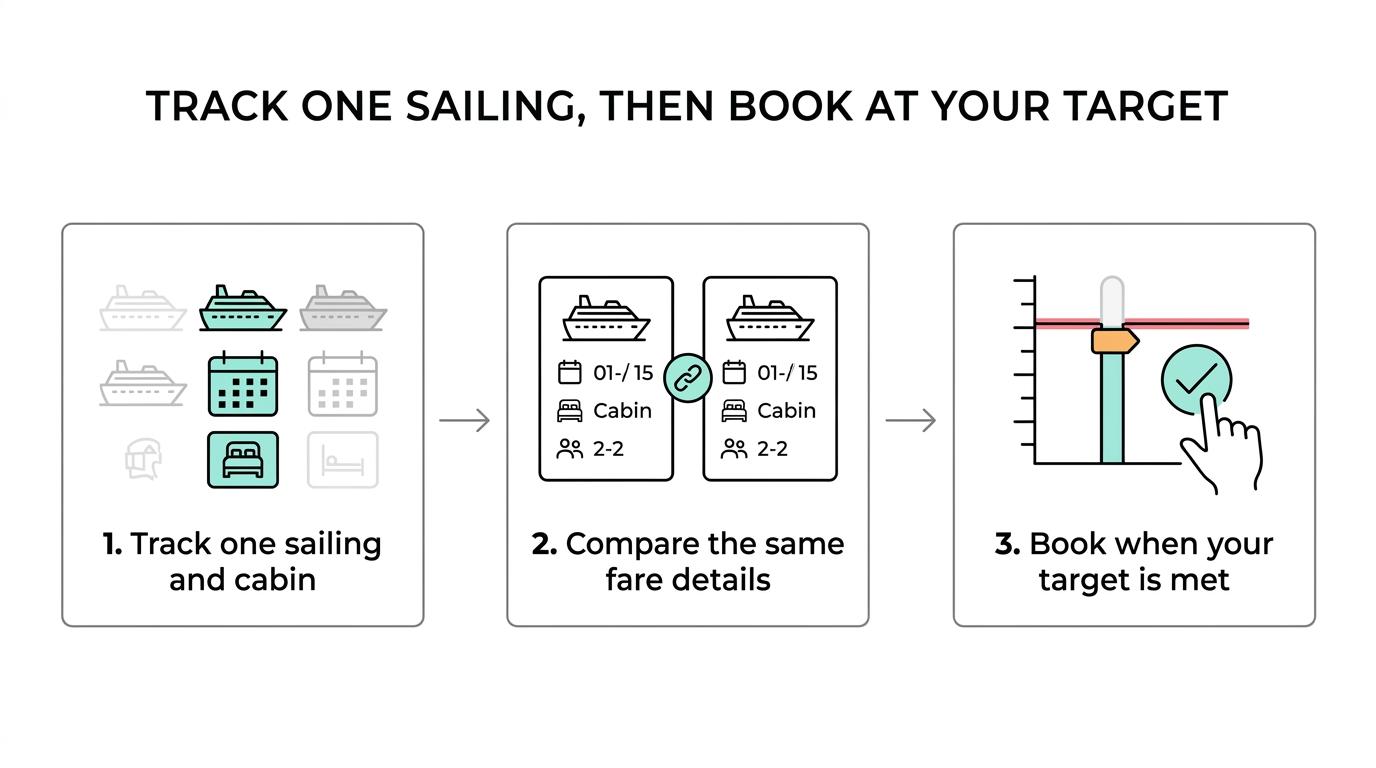
Step 1 is to narrow the market. Pick your region, date range, and a true fallback option. “Caribbean from Florida in late summer” is trackable. “Anywhere warm sometime this year” is not.
Step 2 is to compare like for like. Save the specific ship, date, cabin category, and occupancy. If you track a balcony today and an inside cabin tomorrow, you are not tracking price movement. You are tracking product changes.
Step 3 is to act on thresholds, not feelings. Decide in advance what makes a fare bookable for you. That could be a target total price, a preferred perk bundle, or a refundable rate before final payment. If the deal hits your threshold, book it. Waiting for a slightly better number often costs more than it saves.
“Best Cruise Rates built its last-minute cruise deals workflow for fast-moving offers, so comparison speed matters almost as much as price.”
What should you do before you click book on a flash cruise deal?
Check the fare rules before booking any flash cruise sale. Cabin assignment, cancellation terms, and included perks can matter as much as the visible price.
This is the point where disciplined shoppers save money and casual shoppers create expensive surprises. A guarantee cabin can be a strong value, but only if you are comfortable giving up exact location. A nonrefundable deposit can be reasonable, but only if your dates are stable.
Use a short pre-booking checklist:
- Fare type: refundable, nonrefundable, or guarantee
- Cabin assignment: selected stateroom or cruise-line-assigned
- Included perks: drinks, Wi-Fi, onboard credit, gratuities
- Payment timing: deposit due now and final payment deadline
- Change risk: whether the deal is tied to current inventory only
A quick tip: if two offers are close, the one with simpler terms is often better. Complexity hides trade-offs.
How can you compare cruise promotions without missing hidden trade-offs?
Compare cruise promotions by reducing every offer to total cost, included value, and flexibility. If one sale wins only on the headline fare, it may lose on everything that affects the trip.
Step 1 is to calculate the booking cost. Include fare, taxes, fees, and any immediate add-ons you know you will buy. Step 2 is to price the extras. If one promotion includes drinks or Wi-Fi, give those perks a realistic value based on your habits, not the brochure headline. Step 3 is to score flexibility. A slightly higher fare with better change terms can be the smarter buy.
This is where many travelers misread “free” promotions. If the included perk is something you would not use, it is not value to you. If another fare includes less but keeps better cancellation terms, that may be the stronger deal.
One good if-then rule helps here: if you are price-first and very flexible, prioritize the lowest true total. If you are schedule-first or cabin-first, prioritize availability and terms before chasing one more discount point.
When do flash cruise deals disappear even if the sailing is still on sale?
Flash cruise deals often disappear when the promotional inventory sells out, even though the sailing still has cabins left. The ship may remain available, but not at the same fare or with the same package.
This is the part that frustrates people most. They return to the same sailing and see it still listed, so they assume the earlier price should still apply. But cruise lines often control promotions at the cabin-category or fare-code level. Once that allocation is gone, the next available price can be materially higher even though the voyage itself is not sold out.
Royal Caribbean’s published fare language is a clear example of the broader rule: rates can move without prior notice. Holland America’s reference to current inventory points in the same direction. The sale does not need to end across the entire brand for your specific cabin or sailing to reprice.
If you see a strong fare on a sailing that fits your dates, the practical move is to verify the terms and decide quickly. In flash pricing, hesitation is often a pricing decision of its own.