What Affects Cruise Prices Most From Season to Cabin
In this article
Cruise pricing looks simple from a distance. You see a low advertised fare, a beautiful ship, and a date that seems workable. Then the numbers shift when you change the week, the cabin, or the number of guests in the room.
That is not random pricing. It is how cruise fares are built.
A cruise line is not pricing one product. It is pricing thousands of versions of the same sailing at once, based on timing, demand, inventory, stateroom type, and occupancy rules. If you know which variables matter most, it gets much easier to spot a strong value and avoid comparing fares that are not really comparable.
Cruise price factors go far beyond the advertised fare
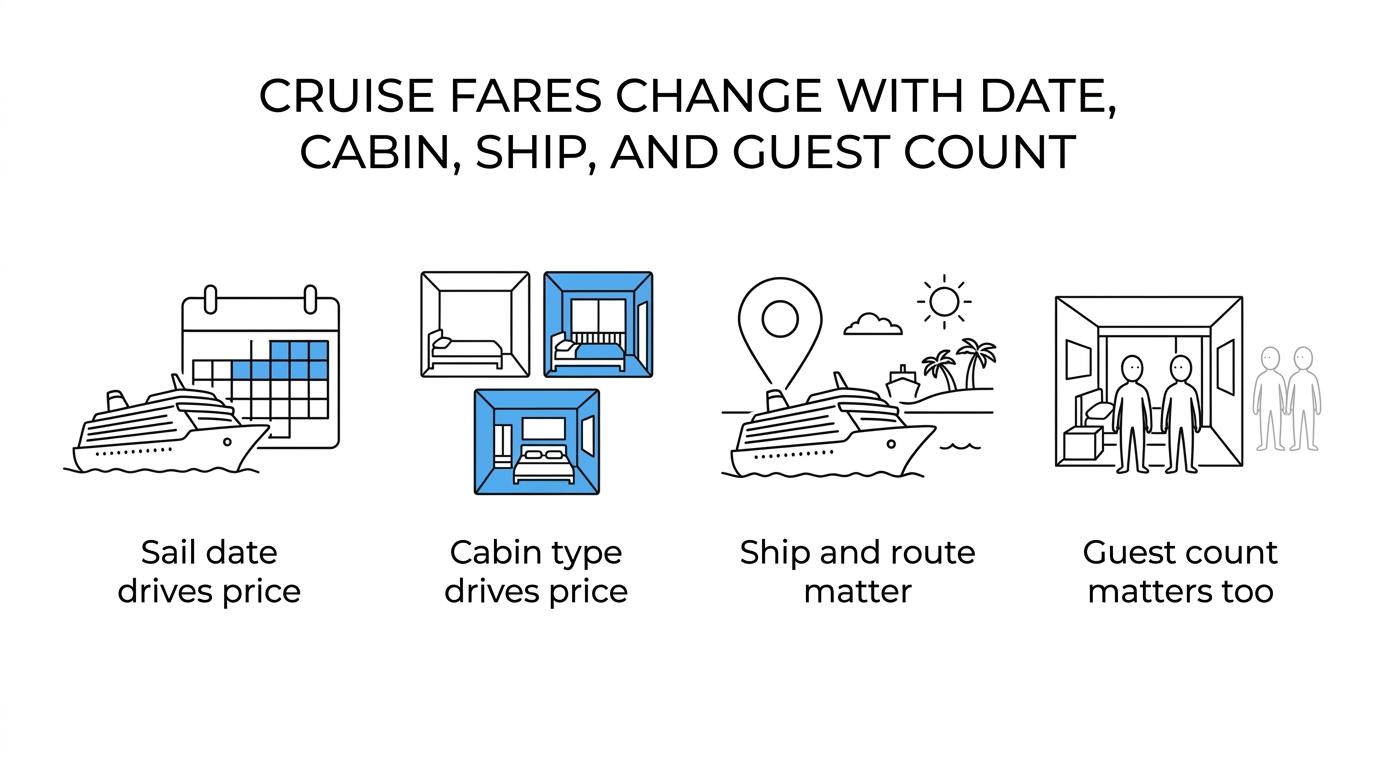
Official cruise line materials make this clear. Royal Caribbean says cruise price varies by ship, sail date, length of cruise, and number of guests per stateroom. Princess also notes that fares are typically based on double occupancy and are subject to change. Those details explain why two cruises that look nearly identical on the surface can price very differently.
The advertised “from” fare also deserves a closer look. Cruise lines commonly base that lead-in price on the lowest stateroom category available. That means the number grabbing your attention may reflect the least expensive cabin on only certain sailings, not the cabin type most travelers actually book.
Here is a quick view of the main pricing drivers.
| Factor | How it affects price | What travelers should watch |
|---|---|---|
| Sailing date | Peak weeks raise fares fast | Holidays, summer, spring break |
| Stateroom category | Higher categories cost more | Inside vs balcony vs suite |
| Ship | Newer or more in-demand ships often cost more | New launches, premium amenities |
| Itinerary | Popular routes and marquee ports can raise fares | Alaska summer, holiday Caribbean |
| Cruise length | Longer sailings cost more in total | Compare total fare and per-night rate |
| Occupancy | Price often assumes two guests in a room | Solo supplements, 3rd/4th guest pricing |
| Inventory and demand | Prices move as cabins sell | Limited categories can disappear early |
Sailing season and sail date have the biggest impact on cruise prices
If there is one factor that tends to move cruise prices first and fastest, it is timing.
A seven-night Caribbean sailing in early September may look very different from a similar itinerary over Christmas week. The ship may be the same. The ports may be nearly the same. The onboard experience may be close. Yet the fare can change sharply because the demand profile is different.
School calendars matter. Holiday travel matters. Weather patterns matter. Regional cruise seasons matter too. Alaska has a defined warm-weather window, which concentrates demand. Warm Caribbean sailings surge when much of the country is cold. Short sailings from Florida during popular long weekends can also rise quickly.
Cruise booking season matters as well. January through March is widely known across the industry as Wave Season, a major booking period. Cruise lines often release promotions during that stretch, but that does not mean every fare drops to its lowest point. High consumer interest can keep pressure on popular departures, cabin categories, and new ships.
The sail date itself is often more powerful than the month you happen to book.
Common high-demand periods include:
- Summer school break
- Christmas and New Year’s week
- Thanksgiving sailings
- Spring break dates
- Peak Alaska departures
- New ship debut periods
This is why date flexibility is so valuable. Moving your departure by even a week can change the fare more than any promo code ever will.
Stateroom category can change a cruise fare dramatically
After timing, cabin choice is usually the next biggest price driver.
Princess states plainly that cabin category is a major determiner of total cruise cost, and that tracks with how fares are presented across the industry. The lowest advertised rates are usually tied to the lowest stateroom category. As you move from inside cabins to ocean view, balcony, and suite categories, the price usually rises in clear steps.
That may sound obvious, but the size of those steps is what surprises many travelers. On one sailing, the jump from inside to balcony may feel modest. On another, especially one with strong demand or limited inventory, it can be substantial.
Cabin location also matters inside a category.
A midship balcony on a preferred deck may price above a balcony at the front or back of the ship. Connecting rooms, larger layouts, and cabins with premium views can add another layer. Suites then move into a different part of the pricing ladder, often with added space, better locations, and sometimes extra benefits.
One advertised number rarely tells the real cabin story.
Why “from” cruise fares can feel lower than the cruise you actually want
Cruise lines often calculate their lead-in or “from” fares using the lowest stateroom category available. Royal Caribbean says that published “from” fares may be based on the lowest stateroom category and may not be available on all sail dates. Princess uses similar language around lead-in original fares.
That means a shopper may click on a fare expecting a balcony and find that the advertised rate only applied to an inside cabin on a different week.
A smarter comparison starts with the cabin you would genuinely book, not the cheapest cabin that happens to exist in the system.
Ship, itinerary, and cruise length also move cruise prices
Once you control for date and cabin, the ship itself becomes easier to evaluate.
Newer ships usually command more attention and often higher pricing. They tend to have fresh entertainment, expanded dining, modern staterooms, and more buzz in the market. A beloved older ship on a similar route may still offer excellent value, especially if your priority is itinerary over onboard novelty.
Itinerary quality also shapes fare levels. Ports with broad appeal, fewer available departures, or strong seasonal demand often cost more. A cruise that includes a highly sought-after route or departure port can price above a simpler itinerary even when the trip length matches.
Cruise length changes the math in two ways. Total fare rises as nights increase, yet the nightly rate does not always rise with it. A longer sailing can offer a better value per night than a shorter trip on a premium weekend date. This is why looking only at the full price can be misleading.
Price pressure often rises with these itinerary traits:
- Newer ships: More demand and fewer discounts early on
- Prime itineraries: Alaska in summer and holiday Caribbean weeks often price higher
- Convenient departure ports: Easy-drive U.S. ports can attract heavy local demand
- Short peak sailings: Weekend and holiday cruises may carry strong per-night pricing
Occupancy and guest count change the per-person cruise price
This is one of the least discussed fare drivers, yet it matters a lot.
Princess notes that fares are generally quoted based on double occupancy. In plain terms, the cruise line is often assuming two guests share the cabin cost structure. If only one traveler books that room, the per-person math can shift sharply because solo pricing often reflects part or most of the second guest’s share.
Three- and four-guest pricing adds another twist. In some cases, the first two guests carry most of the cabin fare, while the third and fourth guests pay reduced cruise fares plus taxes and fees. In other cases, the room category needed to fit more people is more expensive from the start, offsetting the lower extra-guest rate.
The right question is not just “What is the per-person price?” It is “What is the total cost for the exact room and guest mix I need?”
Real-time demand makes cruise prices move faster than many travelers expect
Cruise demand has remained strong. CLIA reported global cruise passenger volume of 37.2 million in 2025, and nearly 90% of cruisers said they intend to sail again. That kind of repeat interest supports active pricing across many lines and destinations.
When demand is healthy, popular cabin categories can disappear early. Peak-season sailings often sell out months ahead, especially for families wanting specific room types or locations. Once lower categories are gone, the fare shoppers see is no longer anchored by those least expensive rooms.
This is where real-time search platform matters. A live booking engine can show what is actually available now, not what was theoretically available when a promotion launched. Platforms that compare sailings by cruise line, ship, embarkation port, destination, and date range make it easier to see whether a price jump is tied to season, inventory, or cabin mix.
If you are watching a sailing with limited cabins left, waiting can work against you more often than many travelers expect.
How to compare cruise prices with more confidence
The best price is not always the lowest number on the first screen. It is the fare that gives you the best mix of date, cabin, ship, and itinerary for your budget.
That means comparing side by side, not one sailing at a time. It also means paying attention to what changed when the price changed.
A practical shopping approach looks like this:
- Check nearby sail dates: A one-week shift can produce a very different fare
- Compare the same cabin type: Inside versus inside is a fair test, balcony versus balcony is a fair test
- Review the guest count: Two guests, three guests, and solo pricing can tell very different stories
- Look at the ship and route together: A lower fare on a less desirable itinerary may not be the better value
- Watch live inventory: The lowest category can disappear before the sailing sells out
It also helps to compare more than one cruise line at once. A real-time search platform can surface pricing patterns quickly, especially if you are flexible on ship or departure date. Expert support can add value too, particularly when the cheapest visible option is not the best fit for your group size, cabin needs, or travel goals.
A strong cruise search is not about chasing one magic sale window. It is about seeing the moving parts clearly, then acting when the right combination appears.
If you keep your eye on the two biggest drivers, when you sail and which stateroom you choose, you will already be making much sharper cruise price decisions than the average shopper.