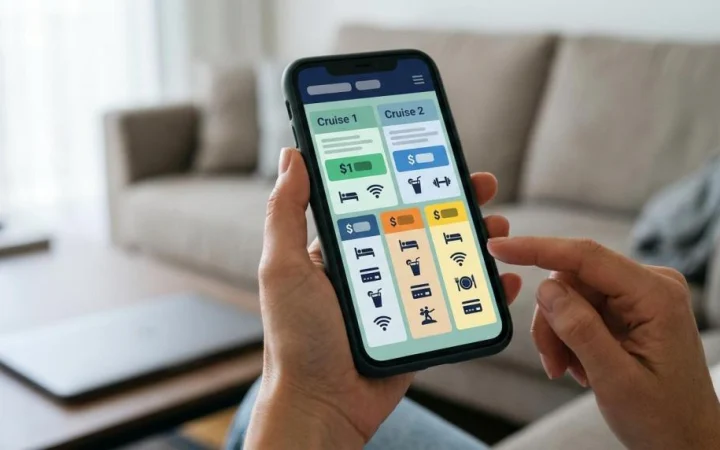
Is a Cruise Drink Package Worth It? Do the Math
Is a cruise drink package worth it? Use the break-even math, real package prices, gratuity rules and port-day adjustments to decide before you pay for it.
In this article
A cruise drink package is worth it when your honest daily drink count beats the break-even number, which on most mainstream lines in 2024-2025 lands somewhere between 5 and 8 alcoholic drinks per person per day. Below that, you almost always save money paying as you go, and the gap widens on itineraries with lots of port time, sea sickness days, or a travel partner who barely drinks.
That is the short answer. The longer answer matters because the break-even number is not fixed. It moves with the package price you are quoted, the gratuity that gets added on top, the price of the specific drinks you actually order, and the rule on nearly every major line that both adults sharing a cabin have to buy the package. This guide walks through the arithmetic step by step, with the real variables, so you can run the number for your own sailing instead of trusting a forum post about someone else's cruise three years ago.
How do you calculate the break-even point on a cruise drink package?
Divide the all-in daily package price, gratuity included, by the average price of the drinks you actually order. That quotient is the number of drinks per day you must consume just to get back to even.
The formula:
Break-even drinks per day = (Package daily price x 1.18 to 1.20 gratuity) ÷ average drink price
Three worked examples using typical 2024-2025 mainstream pricing:
| Scenario | Package/day | With ~18-20% gratuity | Your average drink | Break-even drinks/day |
|---|---|---|---|---|
| Value pre-cruise sale | $65 | $77 | $12 cocktail | 6.4 |
| Typical onboard price | $89 | $105 | $13 cocktail | 8.1 |
| Beer and wine drinker | $75 | $89 | $9 beer | 9.9 |
| Premium package, pricier pours | $105 | $124 | $16 cocktail | 7.8 |
Two things jump out. First, the cheaper your drink of choice, the harder the package is to justify. A dedicated beer drinker needs close to ten cans a day on a $75 package, which is a lot of beer for a lot of days in a row. Second, buying the package onboard instead of pre-cruise can add 20 to 30 percent to the price on several lines, which pushes break-even up by a drink or two per day.
Why gratuity changes the answer more than people expect
Most lines add a service charge to beverage packages. Royal Caribbean's own beverage package terms state that an 18 percent gratuity is added to the package price. Carnival's Cheers! program, per Carnival's FAQ, is priced with the gratuity already folded into the advertised rate when purchased pre-cruise, which is why its sticker price looks higher than some competitors' pre-gratuity numbers. Norwegian historically handled it as a 20 percent service charge on the value of the Free at Sea beverage promotion.
Whatever the line, check whether the number you are comparing includes the service charge. Comparing a pre-gratuity package price against a post-gratuity bar tab is the single most common mistake in this calculation, and it can make a package look $15 a day cheaper than it is.
Do not forget to multiply by cabin occupancy and days
The real decision is not "is $89 a day worth it." It is "is $89 a day, times two adults, times seven days, worth it." That is roughly $1,250 with gratuity on a week-long sailing for a couple. Framed that way, you are deciding whether to prepay an amount equal to a decent chunk of the cruise fare itself. On some discounted Caribbean sailings, the drink package for two can cost more than the cabin.
What are cruise drink packages actually priced at in 2024-2025?
Mainstream unlimited alcohol packages generally run $70 to $120 per person per day before or after gratuity depending on the line, with premium and luxury lines either including drinks or charging a smaller supplement.
Prices move constantly and vary by ship, sailing length and promotion, so treat the following as ranges rather than quotes. Always check the line's own cruise planner for your specific sailing date.
| Line | Package name | Typical range per person/day | Notes |
|---|---|---|---|
| Royal Caribbean | Deluxe Beverage Package | roughly $70-$110 | 18% gratuity added per RCI's terms; frequent pre-cruise sales |
| Carnival | Cheers! | roughly $60-$85 | Carnival's FAQ notes a 15-drink daily limit on alcoholic beverages |
| Norwegian | Premium Beverage Package | often bundled via Free at Sea | Service charge applies to the promotional value |
| Princess | Plus / Premier fare bundles | drinks bundled into fare add-on | Per-drink price caps apply |
| MSC | Easy / Premium Extra | roughly $45-$90 | Lower-cost tiers with narrower drink lists |
| Celebrity | Classic / Premium drinks | often included in "All Included" fares | Price caps by tier |
| Virgin Voyages | Bar Tab (prepaid credit) | no unlimited package | Pay-as-you-go with bonus credit promos |
A few structural notes worth understanding before you compare:
- Price caps. Most packages cover drinks up to a per-item price ceiling. If a cocktail costs more than the cap, you pay the difference, not the full price. That is usually a reasonable deal, but it means the top-shelf pour you were planning on may not be fully free.
- Daily drink limits. Carnival's Cheers! program caps alcoholic drinks at 15 per 24 hours according to Carnival's published FAQ. Several other lines apply similar limits. This mostly matters for group sharing attempts, which are prohibited anyway.
- Bundled fares. Princess and Celebrity have moved toward bundling drinks, Wi-Fi and gratuities into higher fare tiers. On those lines the question becomes "is the fare upgrade worth it," which changes the math because you are also getting internet and crew appreciation included.
The bundled-fare twist
When drinks arrive as part of a fare bundle, strip the bundle apart before judging it. If the upgrade costs $60 per person per day and includes drinks, Wi-Fi worth maybe $20 a day, and prepaid gratuities worth $16 to $20 a day, the effective drink cost is more like $20 to $25 a day. That is a genuinely low break-even, often two drinks. Bundled fares are frequently the best value in this entire category, and they are easy to dismiss because the sticker price looks big.
What counts as a "drink" in the break-even math?
Everything the package covers counts, which is why specialty coffees, bottled water, fresh juice, sodas and mocktails can quietly carry a package that alcohol alone would not.
Most unlimited alcohol packages include:
- Cocktails, beer, wine by the glass, spirits up to the price cap
- Soda and fountain drinks
- Bottled still water (often limited sizes)
- Specialty coffee and tea from the onboard coffee shop
- Fresh-squeezed juice
- Non-alcoholic cocktails and smoothies
That list changes the arithmetic for a lot of people. Consider a traveler who has two lattes, one bottled water, three glasses of wine and a mocktail each day. At per-item prices of roughly $5 for a latte, $4 for bottled water, $12 per glass of wine and $9 for a mocktail, that is about $5+$5+$4+$36+$9 = $59 before the 18 to 20 percent gratuity the bar adds to individual drinks, so roughly $70 all in. Against a $77 all-in package, that traveler is slightly behind but close enough that one extra evening cocktail flips it.
The lesson: count the coffee. A two-latte-a-day habit is worth about $12 per day with gratuity and shaves roughly one drink off your break-even requirement.
What is usually not included
- Drinks above the price cap (you pay the overage)
- Bottles of wine, though some lines offer a discount
- Room service beverage deliveries in some cases
- Drinks at private islands or port bars operated by third parties, though most lines do honor packages at their own private destinations
- Canned energy drinks on some lines, souvenir glassware, vending machines
Before you buy, pull up the specific package's inclusion list on the cruise line's site. Lines revise these lists, and an assumption from an earlier sailing may be out of date.
When is a drink package clearly worth buying?
Buy it when you reliably drink six or more alcoholic beverages a day, when both adults in the cabin drink at similar levels, and when your itinerary is sea-day heavy.
The clearest "yes" profiles:
1. The sea-day sailor. Transatlantic crossings, long Pacific repositionings and Panama Canal itineraries stack up sea days where you are on the ship from breakfast to midnight with a bar always within thirty feet. A seven-night Caribbean cruise with five port days gives you maybe four or five waking hours a day aboard on those days. A twelve-night repositioning crossing with eight sea days gives you the whole thing. If you are weighing a crossing, our breakdown of why repositioning cruises cost less per day explains the itinerary structure, and that same structure is exactly what makes a drink package pay off.
2. The evening-plus-afternoon couple. Two drinks by the pool, a pre-dinner cocktail, wine with dinner, and a nightcap is five to six drinks. At $13 to $15 a cocktail with gratuity, that is $75 to $100 a day in pay-as-you-go spending. Package territory.
3. The specialty coffee and soda household. A family where the adults drink moderately but everyone wants lattes, smoothies and sodas all day can hit break-even with less alcohol than the headline number suggests, especially if the line sells a cheaper non-alcoholic package for the teenagers.
4. Anyone who hates the running tab. There is a real, if non-financial, value in not mentally pricing every drink. Some travelers spend less overall because they do not feel the pull of "well I already paid, let me order another." Others genuinely enjoy the vacation more. If a $200 premium over pay-as-you-go buys a week of not thinking about it, that is a legitimate purchase, just be honest that you are buying convenience, not savings.
5. Holiday and party sailings. Festive sailings tend to run longer bar hours and more deck events. Our look at a Royal Caribbean 4th of July cruise's onboard costs shows how peak-week pricing and a packed event calendar push onboard spend up across the board.
When should you skip the drink package?
Video: "Why More Cruisers Are Ditching the Drink Package—And What They’re Doing Instead" — Royal Caribbean Blog (YouTube)
Skip it when you drink fewer than four a day, when your itinerary is port-heavy, when one adult in the cabin is a light drinker, or when you are sailing a line where wine and beer are inexpensive.
Port-intensive itineraries. On a Mediterranean cruise with eight ports in ten nights, you may be ashore from 8 a.m. to 5 p.m. most days, eating and drinking locally. You get maybe four onboard drinking hours on those days. A package priced at $100 a day for maybe three ship drinks is a straightforward loss. The same logic applies to Alaska, where scenery and shore excursions eat the day, and to Asia itineraries where food ashore is a central reason you booked. If you are planning a dense port schedule like the ones in our Southeast Asia cruise in January guide, run your numbers using only the hours you will realistically be aboard and awake.
The mismatched couple. Nearly every major line requires both adults sharing a stateroom to purchase the package if one does. Royal Caribbean's beverage package terms state this explicitly. So if you drink eight a day and your partner drinks one, your effective household break-even is not 7 drinks, it is 14 drinks across two people. You are paying roughly $155 a day for two packages to replace maybe $115 of actual consumption. In this case, pay as you go, or check whether the line offers a cheaper non-alcoholic or refreshment package for the light drinker, which sometimes satisfies the "both adults must purchase" requirement.
Short sailings with embarkation-day disruption. On a three-night cruise, day one starts mid-afternoon and the last day you disembark before breakfast. You are paying for three days and getting roughly two and a half usable ones. Three-night packages rarely pencil out unless you are genuinely drinking hard.
Days you lose. Seasickness, a long excursion that wipes you out, a nap that eats the afternoon, an early night before a 7 a.m. tender. Most people lose at least one of these per week. Build it in: if you assume seven usable days on a seven-night cruise, you are being optimistic.
The honest self-assessment problem
Nearly everyone overestimates their vacation drinking. The decision gets made during booking, when a week of umbrella drinks sounds great, and gets paid for whether or not reality cooperates. A useful discipline: think about your last cruise or last all-inclusive resort week and recall specific drinks on a specific day, not an average. Most people who think "I probably have eight a day" land closer to five when they count honestly.
How does the first-day trial method work?
Pay as you go on embarkation day and your first full day, keep your receipts, then buy the package onboard if your actual spending justifies it.
This is the most reliable way to get the answer right, with one important caveat: the onboard price is usually higher than the pre-cruise price, often by 20 to 30 percent, and some lines do not sell packages after the first day or two of the sailing. Check your line's specific policy, which is normally in the beverage package terms on their website.
The trial works like this:
- Order normally on day one and day two. Do not consciously drink more or less than usual.
- Check your folio on the stateroom TV or the app at the end of day two. Most lines show an itemized running account.
- Divide your two-day beverage spend by two to get your daily average.
- Multiply the onboard package price plus gratuity by your remaining days.
- Compare that against your daily average times remaining days.
If the package wins by a comfortable margin, buy it. If it is within 10 percent, skip it, because you will probably not drink more on days six and seven than you did on days one and two. Embarkation day and the first sea day are usually the heaviest drinking days of a cruise.
The counter-argument: if your line runs a deep pre-cruise sale, say 40 percent off, the discount may be large enough that buying blind pre-cruise beats buying onboard even after accounting for the risk that you drink less than planned. Run both numbers. If the pre-cruise price is $65 all-in and the onboard price is $95 all-in, the pre-cruise price is cheap enough that break-even drops to about five drinks a day, which is a much easier bar to clear.
Can you cancel a pre-purchased package?
Most lines allow cancellation of pre-purchased cruise planner items up to a few days before sailing, with a refund to the original payment method. Royal Caribbean, Carnival and Norwegian all operate cruise planner systems with pre-sailing cancellation windows. That means buying during a sale and re-evaluating later is usually low risk, as long as you cancel before the deadline. Check the cancellation terms at checkout, and set a calendar reminder for three days before the published cutoff.
This also enables price-tracking. If you buy the package at $89 and it later drops to $69 in a flash sale, many cruisers cancel and rebuy at the lower price. The lines permit this within their own cancellation terms.
What about non-alcoholic, soda and refreshment packages?

Photo: Darwin Bell · BY
Refreshment packages that cover soda, specialty coffee, bottled water, juice and mocktails typically run $25 to $40 per person per day and break even at roughly four to six non-alcoholic drinks, which is easier to hit than people expect.
These often get overlooked and are frequently the better buy for families. Consider the per-item pricing on most mainstream ships:
- Soda from a bar: roughly $3.50 to $4.50 plus gratuity
- Specialty coffee: roughly $4 to $6 plus gratuity
- Bottled water: roughly $3 to $5 plus gratuity
- Fresh juice: roughly $5 to $7 plus gratuity
- Mocktail: roughly $8 to $10 plus gratuity
A teenager who drinks four sodas and a smoothie daily is spending around $27 before gratuity, roughly $32 with it. A $30 refreshment package is already ahead. A soda-only package, usually $12 to $20 a day, breaks even at three or four sodas.
Also check whether your fare already covers basics. Tap water, standard drip coffee, iced tea, lemonade and juice at breakfast are complimentary on essentially every mainstream line. A traveler who is content with those does not need any package at all.
The kids-package rule
On most lines, children in a stateroom with a package-buying adult are not required to buy anything, but adults are. Verify this on your specific line, because the "all adults in the cabin" rule is enforced by most major brands and the definition of adult (18 vs 21) varies.
Can you bring your own alcohol on a cruise?
Most major lines allow a limited amount of wine or champagne brought aboard at embarkation, typically one 750ml bottle per adult, often with a corkage fee if consumed in a dining venue, and most prohibit hard liquor and beer entirely.
Published policies as of recent updates:
- Royal Caribbean permits guests 21 and older to bring one 750ml bottle of wine or champagne per stateroom at embarkation, per the line's own alcohol policy page. Liquor and beer are not permitted.
- Carnival allows one 750ml bottle of wine or champagne per adult 21 or older at embarkation, per Carnival's alcohol policy, with a corkage fee if opened in a dining room or bar.
- Norwegian has historically applied a corkage fee to wine brought aboard.
- Disney Cruise Line has been among the more generous, historically permitting two bottles of wine or six beers per adult at each embarkation and port stop. If you are tracking Disney's fleet expansion, see our piece on the Disney Believe's Fort Lauderdale debut.
Non-alcoholic rules are usually more permissive. Several lines allow a modest quantity of sealed non-alcoholic drinks in carry-on, often 12 standard cans or cartons per person. Bottled water policies have tightened in recent years, so confirm before you pack a case.
What this means for the math: if you can legally bring two bottles of wine aboard for a couple, that is roughly eight to ten glasses, worth $100 to $130 at onboard prices, and it reduces your package case by about one drink per day on a week-long cruise.
Attempting to smuggle liquor is a bad idea. Lines screen luggage, confiscate what they find, and in some cases charge the guest or deny boarding. The savings do not justify the risk.
How does the itinerary change the break-even number?
Port-heavy itineraries can cut your onboard drinking hours by 40 to 60 percent on port days, which effectively raises the price per drink you actually consume.
A practical way to adjust: count usable drinking days, not calendar days.
| Day type | Usable drinking hours aboard | Count as |
|---|---|---|
| Embarkation day (3 p.m. boarding) | 7-8 | 0.75 day |
| Full sea day | 12-14 | 1.0 day |
| Port day, back aboard by 4 p.m. | 7-8 | 0.75 day |
| Port day, back aboard by 10 p.m. | 2-3 | 0.3 day |
| Overnight in port | 2-4 | 0.3 day |
| Disembarkation morning | 0-1 | 0.0 day |
Run a seven-night Eastern Caribbean itinerary with embarkation, two sea days, three port days returning around 5 p.m., and disembarkation: 0.75 + 2.0 + 2.25 + 0 = 5.0 usable days. You pay for seven. Your effective cost per usable day is 40 percent higher than the advertised rate.
Now run a fourteen-night Panama Canal partial transit with seven sea days: 0.75 + 7.0 + 4.5 + 0 = 12.25 usable days out of 14. Much better ratio. Our comparison of full versus partial Panama Canal transits lays out how the two itinerary styles differ in sea-day count, and that difference is material to this decision.
Likewise, a winter Gulf cruise with a long stretch at sea behaves differently than a dense port-hopping route. Our Dubai cruise in winter guide covers an itinerary style with short hops and heavy shore time, which generally argues against a package.
Does the drink package make sense on a budget cruise?
On a deeply discounted sailing, the drink package can easily cost more than the cruise fare itself, which is a useful signal that you should probably pay as you go.
Say you book an inside cabin on a shoulder-season Caribbean sailing at $599 per person for seven nights. Two Deluxe-style packages at $89 a day with gratuity run about $1,470 for the week. You would be more than doubling the trip cost to cover drinks. Unless you are a genuinely heavy drinker, that is a hard sell.
This is the main reason value-focused cruisers tend to skip packages. If your entire strategy is finding a low fare, pairing it with the most expensive onboard add-on undoes the work. Our guide to the cheapest months to cruise the Caribbean covers where those low fares come from, and those same sailings are the ones where the package-to-fare ratio looks worst.
The opposite also holds. On a premium or luxury line where the fare already runs $400 to $600 per person per day, a beverage supplement of $50 to $80 is a small percentage of total spend and often includes better pours. Several luxury lines include drinks in the fare entirely.
What hidden costs should you factor in?
Beyond the package price and gratuity, check price caps, the single-cabin-purchase rule, specialty venue exclusions and private island coverage.
Price caps and overages. If the cap is $14 and the martini is $18, you pay $4 plus gratuity on the $4. Reasonable, but if your preferred drinks routinely exceed the cap, the premium package tier may be the better buy even though it looks more expensive.
Automatic bar gratuity on individual drinks. Pay-as-you-go drinks carry an 18 to 20 percent service charge too. When you build your pay-as-you-go comparison, add it. A $13 cocktail is $15.34 at 18 percent. Forgetting this understates your pay-as-you-go spending by roughly a sixth and makes the package look worse than it is.
Sharing is prohibited and enforced. Packages are tied to your SeaPass or cruise card and photo. Buying one package for two people does not work. Crew can and do confiscate cards for repeated violations.
Specialty restaurants and events. Most packages work in specialty dining rooms, but a few venues, wine pairing dinners, mixology classes and chef's table events are excluded. If you have booked three specialty dinners, part of your drinking week moves into a partially excluded zone.
Private islands. Most lines honor packages at their own private destinations such as Perfect Day at CocoCay, Half Moon Cay or Great Stirrup Cay. They do not honor them at independent bars in regular ports. Check whether your itinerary's beach day is line-operated or third-party.
What is the simplest decision rule?
If you can honestly say both adults in your cabin will average six or more package-covered drinks per day across the whole sailing, buy it during a pre-cruise sale. Otherwise pay as you go and reconsider onboard.
Here is a compact checklist to run before you click buy:
- Find the all-in daily price. Package price plus gratuity, for your specific sailing, not a generic figure.
- Pick your typical drink and its price. Cocktail, wine by the glass, beer, or a blend.
- Divide. That is your break-even drinks per day.
- Count usable days using the table above, not calendar days.
- Count both adults. If one is a light drinker, the household break-even roughly doubles.
- Add the non-alcoholic items you would genuinely buy: coffee, bottled water, soda, juice.
- Check cancellation terms so you can reverse the decision if a better price appears or your plans change.
- Decide with a margin. If the math is within 10 percent either way, skip the package. People drink less than they plan, not more.
A quick reference table
| Your honest daily drink count | Recommendation |
|---|---|
| 0-2 | Skip. Pay as you go, or buy a soda/refreshment package only. |
| 3-4 | Skip unless the package is deeply discounted under $55 all-in. |
| 5-6 | Borderline. Buy only on a pre-cruise sale and sea-day-heavy itinerary. |
| 7-9 | Buy, especially pre-cruise. |
| 10+ | Buy, and consider the premium tier for higher price caps. |
Do drink packages ever go on sale, and when should you buy?
Cruise lines run beverage package promotions through their online cruise planners, often during Black Friday and Cyber Monday, Wave Season in January through March, and in the weeks immediately before a sailing when inventory needs moving.
Practical approach:
- Buy early during a sale if the price is genuinely good, knowing you can usually cancel for a refund before the pre-sailing deadline.
- Keep checking the price in your cruise planner. If it drops, cancel and rebook at the lower rate within the line's terms.
- Do not wait until you board expecting a deal. Onboard pricing is typically the highest price offered.
- Watch for bundled promotions. Lines frequently pair drinks with Wi-Fi, gratuities and shore excursion credit at a better effective rate than drinks alone.
What else should you sort out before you book?
Beyond onboard spend, confirm documentation requirements, because a booking problem costs far more than any drink package decision. Entry rules vary by itinerary type, and closed-loop sailings from US ports follow different requirements than one-way or foreign-embarkation cruises. Our guide on whether you need a passport for a cruise breaks it down by itinerary.
Once documentation and fare are settled, the drink package is the single largest discretionary onboard decision most cruisers make. Treating it as arithmetic rather than a vibe is the whole trick.
Frequently asked questions
Does everyone in the cabin have to buy the drink package?
On most major lines, all adults of drinking age sharing a stateroom must purchase the same package if one does. Royal Caribbean states this in its beverage package terms. Children and teens generally do not have to buy anything.
Can I buy the package for only part of the cruise?
Generally no. Packages are sold for the full length of the sailing. If you buy onboard after day one, some lines charge for the remaining days, and some charge for the full cruise regardless. Ask at the bar or guest services before purchasing.
Is the premium tier worth the upgrade over the standard tier?
Only if you regularly order drinks above the standard tier's price cap. If your typical cocktail is $13 and the standard cap is $14, you are paying extra for headroom you will not use. If you drink single-malt scotch or craft cocktails at $17 to $20, the premium tier can pay for itself.
Do drink packages work on private islands?
At the cruise line's own private destinations, usually yes. At independently operated bars in regular ports, no.
What happens if I get sick or skip days?
Nothing. Packages are not prorated or refunded for unused days once the cruise begins. This is the main downside risk and the reason to be conservative in your estimate.
Is a drink package worth it on a 3-night cruise?
Rarely. Embarkation afternoon and disembarkation morning eat most of two of the three days, so you are paying three days of package price for roughly two usable days of drinking.
Can I share my drink package with my partner?
No. Packages are linked to your cruise card and photo, and sharing is grounds for revocation without refund on every major line.
Ready to compare fares, cabins and itineraries before you worry about onboard spend? BestCruiseRates.com offers free personalized cruise quotes across major lines, and our team can tell you which sailings bundle drinks into the fare and which charge separately, so the total cost is clear before you book.